About Lactarius torminosus (Schaeff.) Pers.
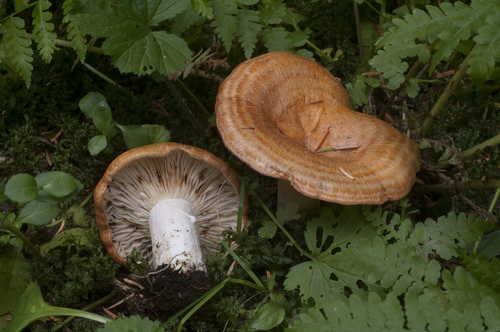
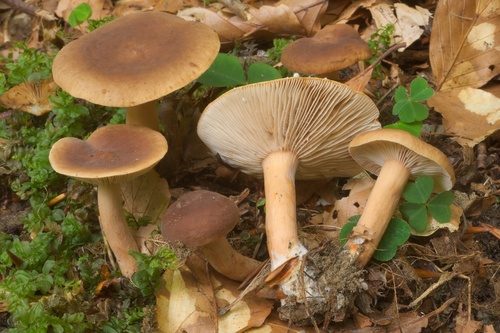
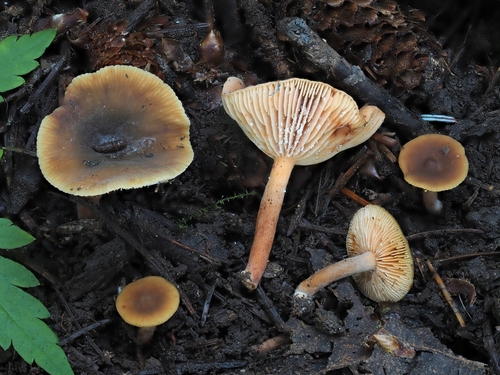
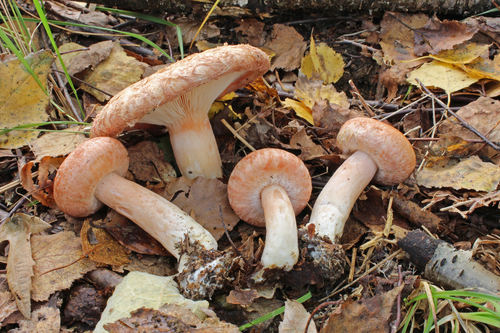
Lactarius torminosus (Schaeff.) Pers. develops its cap shape as it matures: initially convex, it develops a central depression and raised outer edges to become a shallow funnel, reaching a final width of 2 to 12 cm (3⁄4 to 4+3⁄4 in). The cap margin is strongly curled inward; young caps have a thick hairy covering (tomentose) that forms a veil-like structure partially covering the gills, and this tomentum becomes less prominent with age. The cap surface is also tomentose at first, but hairs wear away over time to leave it more or less smooth. Young caps are slightly sticky with distinct darker concentric rings (a zonate pattern), and these rings, especially outer ones, typically fade as the mushroom matures. Cap color ranges from pinkish-orange to pale dull pink, fading to orange or whitish toward the margin as the pink fades. The flesh, which ranges from white to flesh-colored, is firm and brittle when young, becoming flaccid with age. When tissue is cut or injured, it produces white to cream latex that does not change color after prolonged exposure to air, and does not stain the gills. The mushroom has an acrid taste, with a slight to pungent odor. The gills are subdecurrent, meaning they run only a short distance down the stem; they grow close to crowded together, are narrow, and sometimes fork near the stem. They start whitish, develop a pink tinge, and turn pale tan with age. Mature stems measure 1.5–8 cm (1⁄2–3 in) long and 0.6–2 cm (1⁄4–3⁄4 in) thick. They are fragile, roughly equal in width along their length, cylindrical or narrowed at the base. The stem surface is dry, and ranges from smooth to pruinose, covered in a very fine whitish powder. Stem color ranges from pale light pink to yellowish-tinged, slightly pinkish-orange, or orange-white, and sometimes has spots. The stem interior is firm, beige white, and filled with soft pith when young, eventually becoming hollow. Occasionally, white mycelium can be seen at the stem base where it meets the ground. Fruit bodies of L. torminosus develop via pileostipitocarpic formation. In this development type, the hymenium (spore-producing tissue) forms early on the underside of the cap and upper stem of the mushroom primordium. As the cap enlarges, its margin (made of outward- and downward-growing flaring filamentous hyphae) curves inward, eventually forming a tissue flap roughly parallel to the stem surface. With further development, these hyphae contact and adhere to the stem’s hymenial surface, covering already-formed basidia and macrocystidia (very long cystidia). The junction of the two tissues creates a cavity that temporarily protects the basidia, even though the basidia are already fertile when the cap margin begins growing. Microscopically, L. torminosus has a cream to pale yellow spore print. Spores measure 8–10.2 by 5.8–6.6 μm, are roughly spherical to broadly elliptical in side view, and are hyaline (translucent). Only the surface ornamentation of spores is amyloid; the ornamentation is partially reticulate (network-like), with interrupted ridges roughly 0.5–0.7 μm high and a few isolated warts. Spores have a conspicuous apiculus, which marks where they were once attached to the basidia via the sterigma. Basidia are four-spored, hyaline, and club-shaped to cylindrical, measuring 30–47.7 by 7.3–8.2 μm. Pleurocystidia occur only as macrocystidia that originate and are embedded in and just below the hymenium, reaching 40.3–80.0 by 5.1–9.5 μm. Macrocystidia are abundant in the hymenium; they are spindle-shaped to ventricose (swollen on one side), gradually taper in width, and contain granular hyaline contents. Gill edge cystidia (cheilocystidia) are smaller, measuring 30–52 by 4.5–8.0 μm. The cap cuticle is an ixocutis, made of gelatinized interwoven hyphae arranged roughly parallel to the cap surface; the thin-walled, threadlike hyphae in this layer are 2.5–7.3 μm wide. Lactarius torminosus occurs in northern temperate and boreal climates, and sometimes extends into subarctic regions. It has been recorded in North Africa, northern Asia, and Europe, and is common in North America. In North America, its distribution extends north to the Yukon and Alaska and south to Mexico, and it sometimes grows with aspen (Populus species). Lactarius torminosus is a mycorrhizal species, which means it facilitates nutrient and water uptake by trees. It grows in association with birch (Betula) and hemlock (Tsuga) in mixed forests. It also grows in urban areas when birch trees are nearby. A field study in Scotland found the species is more likely to occur in older birch woodlands than younger ones. Fruit bodies grow on the ground, either scattered or grouped. They form part of the red squirrel’s diet, and act as breeding sites for some fungus-feeding flies in the Drosophilidae and Mycetophilidae families. The species may be parasitized by the mold Hypomyces lithuanicus, which produces a cream-ochre to cinnamon-colored granular or velvety mycelial growth on the gill surface and deforms the gills. Raw L. torminosus has an intensely peppery taste that can blister the tongue if sampled in large amounts. Some authors classify the species as outright poisonous, and note it causes mild to fatal gastroenteritis. In a 1930 publication, Hans Steidle reported that while ingested mushroom was not toxic to unicellular and cold-blooded organisms, injecting fruit body liquid extract or pressed juice under a frog’s skin caused disturbed breathing, paralysis, and eventual death. Typical symptoms after eating raw mushrooms include nausea, vomiting, and severe diarrhea that begin about one hour after ingestion. This combination of symptoms can lead to dehydration, muscle spasms, and circulatory collapse. Gastroenteritis usually resolves without treatment within a couple of days. Despite reports of toxicity, L. torminosus is prepared for food in Finland, Russia, and other northern and eastern European countries by parboiling, soaking in brine for several days, or pickling. After preparation, it is valued for its peppery taste. It is harvested for commercial sale in Finland. Analysis of Finnish specimens found the following nutrient composition, measured as a percentage of dry weight: 17.20% protein, 0.46% phosphorus, 0.12% calcium, 0.09% magnesium, 2.97% potassium, and 0.01% sodium.