About Lactarius sanguifluus (Paulet) Fr.
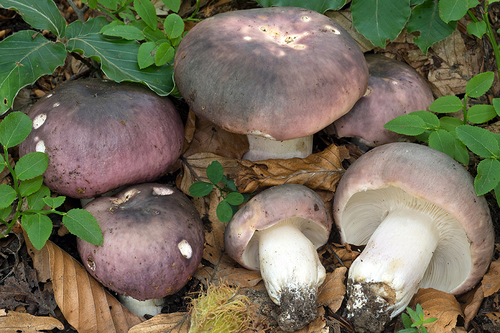
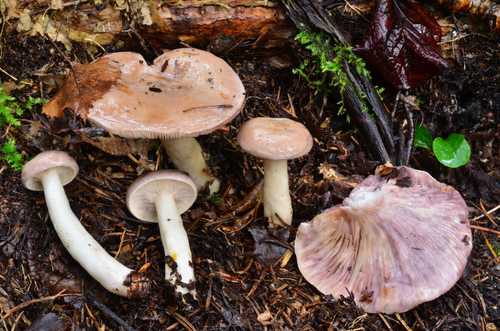
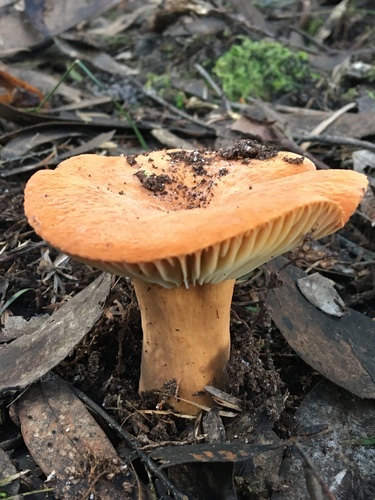
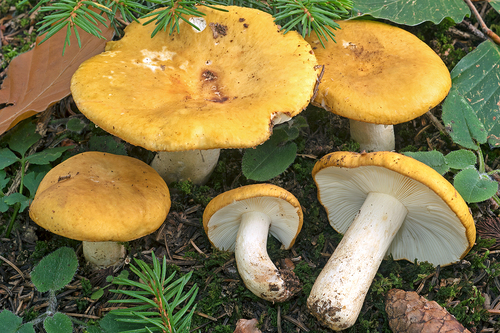
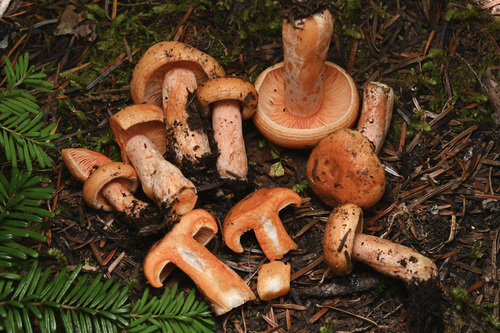
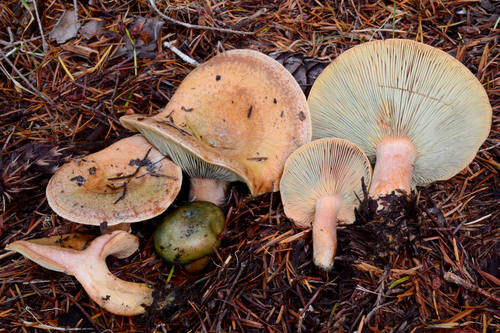
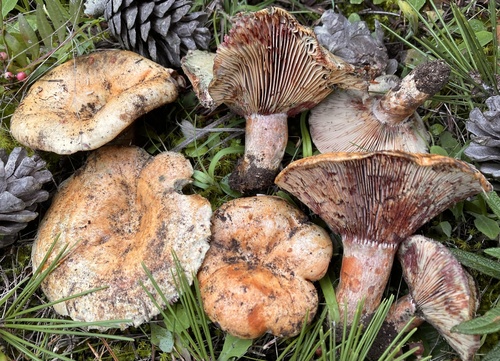
Fruit bodies of Lactarius sanguifluus have convex caps with a central depression, reaching 4–7.5 cm (1.6–3.0 in) in diameter. The cap surface is smooth and sticky, and margins curve downward even when the mushroom matures. The cap is pinkish-buff to orangish, sometimes with patches of grayish or pale greenish-gray, especially where the surface has been bruised. The somewhat crowded gills attach to the stipe in an adnate to slightly decurrent pattern. They are pale vinaceous with a pale pinkish-buff edge. The cylindrical stipe is 2.0–3.5 cm (0.8–1.4 in) long and 1–2 cm (0.4–0.8 in) thick. Its smooth surface is pale pinkish-buff to pale greyish-buff, and sometimes marked with irregular brownish dots. The texture of the flesh ranges from firm to fragile: in the stipe, the flesh is soft and pale pinkish buff; under the cap cuticle it is brick colored, and brownish-red just above the gills. The taste ranges from mild to slightly bitter, and there is no significant distinct odor. Spores are roughly spherical to ellipsoidal, measuring 7.9–9.5 by 8.0–8.8 μm. They have surface ornamentations up to 0.8 μm high, and an almost complete reticulum made of broad, rounded ridges. The spore-bearing basidia are somewhat cylindrical, four-spored, and measure 50–70 by 9–11 μm. The cap cuticle is an ixocutis, which consists of gelatinous hyphae that run parallel to the cap surface. It is up to 60 μm thick, with hyphae 2–6 μm wide that are usually branched and interwoven.
Lactarius sanguifluus is an ectomycorrhizal species, and its fruit bodies grow on the ground in association with pine trees on calcareous soils. It is widely distributed in Himachal Pradesh, India, where it has been observed growing in mixed coniferous forests, usually under the fern Onychium contiguum. It is widespread in Southern Europe, and fruits between September and November, extending to December in the southernmost regions of the continent. In the Netherlands, it has been found in calcareous dunes, growing in a warm, sunny, sheltered location at the edge of a pine-dominated wood. Additional European records include Belgium, Estonia, Greece, Cyprus, France, Germany, Italy, Luxembourg, Poland, Russia, Spain, Slovakia, Sweden, and Switzerland. In Africa, the species has been collected in Morocco; in Asia, it also occurs in Vietnam and China. It is listed in the Red Data Book of Ukraine, and appeared in a draft red list for Spain as an endangered edible species considered vulnerable due to uncontrolled commercial picking. As a documented example, a September 1998 newspaper report cited in the source states that 82.5 kg (182 lb) of L. sanguifluus picked in Poligny were seized from a van.