About Lactarius salmonicolor R.Heim & Leclair
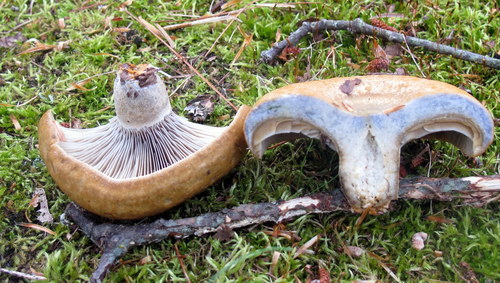
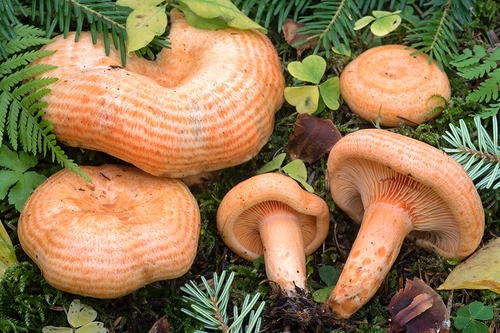
Lactarius salmonicolor R.Heim & Leclair fruits from September to November across most of Europe. This fungus forms an ectomycorrhizal relationship with fir trees, growing primarily near the roots of its host, where it obtains nutrients for growth. The cap (pileus) is orange-reddish on its upper surface; rare green spots may appear on older, decaying specimens. Young caps are convex, and mature caps become slightly depressed at the center, with an irregular shape that sometimes has lobes. The cap surface is smooth and viscid. On the underside of the cap, the lamellas (gills) are evenly spaced, salmon-orange, and usually slightly paler than the upper cap surface. Gills occasionally split as they run down (decurrent onto) the upper section of the stipe, and they turn red when bruised. The stipe is cylindrical, most often long and slender, but rarely short and thick. The flavor of L. salmonicolor is mild and slightly acrid when fresh, turning bitter over time. Its spore deposit is pale yellow to orange. Spores have surface variations including ridges and warts that reach up to 0.5 μm in height. In addition to most of Europe, the species is also found in bogs and conifer forests of Canada, the Great Lakes region, and the northeastern United States. Like most milky caps, Lactarius salmonicolor is commonly used in regional cuisine, particularly in parts of Europe. Because it is widely used across different European cultures, it has many common names, including Italian "fungo del sangue" (blood fungus), French "lactaire couleur de saumon" (salmon colored milk cap), and UK "milky agaric", among others.