About Lactarius rubrilacteus Hesler & A.H.Sm.
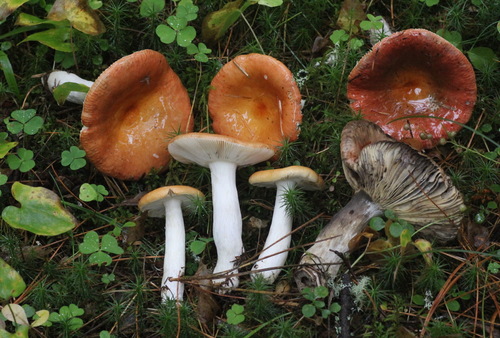
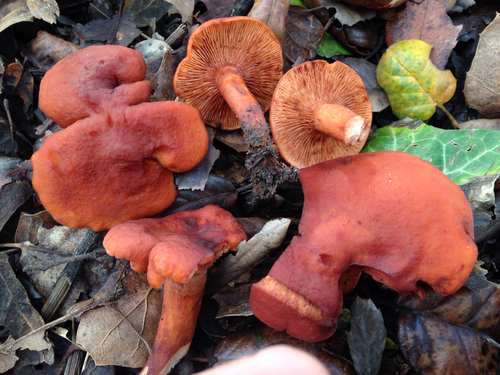
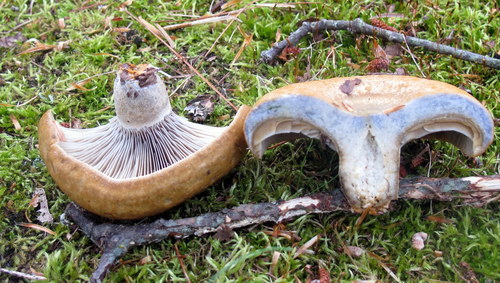
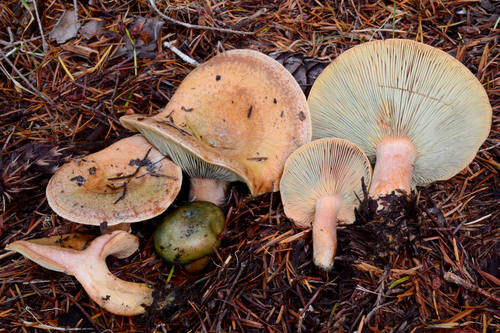
Lactarius rubrilacteus Hesler & A.H.Sm. is a mushroom that can show either a bluish-green or orangy-brown color. It bruises green, and greenish tones are more common in old, damaged, or unexpanded specimens, such as button-stage mushrooms at the base of fungal clusters. It has numerous laticifers that form a visible white network across its surface. The cap ranges from 6 to 14 centimetres (2+1⁄4 to 5+1⁄2 inches) across, is typically convex and sometimes shield-shaped, with a distinctly underfolded margin and a depressed central area. The stem matches the cap in color, growing up to 6 cm long and 2.5 cm thick. When sliced or cut, the mushroom flesh releases a dark red to purple latex, or milky substance. Damaged flesh loses its original color, and has a generally granular or brittle texture. The fungus gives off a faint, slightly aromatic odor. Its spores are ellipsoid in shape and range from creamy white to yellow, and it produces a beige spore print. This mushroom is primarily found in parts of western North America, where it grows on the ground in forests. It most often grows in association with conifer trees, mainly Douglas-fir, and is widely distributed across its range between June and October. It is an edible species, but its grainy texture means it is of little culinary interest. Slow roasting or baking is recommended to reduce its overly grainy texture.