About Lactarius indigo (Schwein.) Fr.
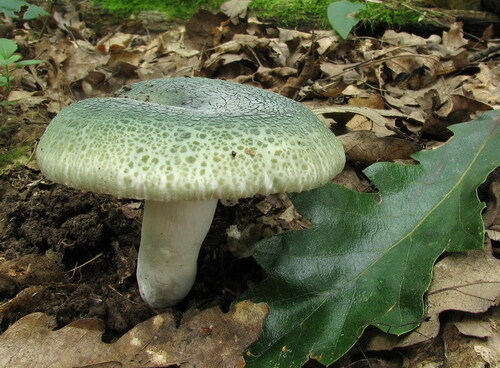
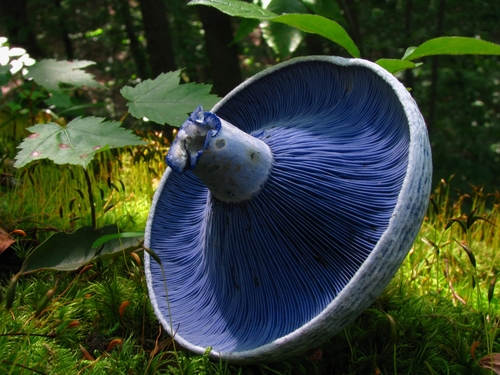
Like many other mushrooms, Lactarius indigo (commonly known as the indigo milk cap) grows from a nodule that forms in underground mycelium—mycelium is a mass of threadlike fungal cells called hyphae that makes up the majority of the organism. When environmental conditions of temperature, humidity, and nutrient availability are suitable, L. indigo produces visible reproductive structures called fruit bodies. The fruit body cap measures 4–15 cm (1+1⁄2–6 in) in diameter. It starts convex, later develops a central depression that deepens with age, and becomes somewhat funnel-shaped as the cap edge lifts upward. The cap margin is rolled inward when young, and unrolls and elevates as it matures. When fresh, the cap surface is indigo blue, fading to a paler grayish- or silvery-blue that sometimes develops greenish splotches. The cap is often zonate, marked with concentric lines that form alternating pale and darker zones, and may have dark blue spots, especially near its edge. Young caps are sticky to the touch. The mushroom’s flesh ranges from pallid to bluish in color, and slowly turns greenish after exposure to air; its taste is mild to slightly acrid. The entire mushroom has brittle flesh, and the stem will snap cleanly open if bent far enough. Injured tissue exudes indigo blue latex that stains the wounded tissue greenish; the latex has a mild taste, like the flesh. Lactarius indigo is known to produce less latex than other Lactarius species, and older specimens in particular may be too dried out to produce any latex. The gills are closely crowded, and range from adnate (squarely attached to the stem) to slightly decurrent (running down the length of the stem). They are indigo blue, becoming paler with age or staining green when damaged. The stem measures 2–8 cm (3⁄4–3+1⁄8 in) tall and 1–2.5 cm (3⁄8–1 in) thick, with the same diameter along its whole length or sometimes narrowing at the base. Its color ranges from indigo blue to silvery- or grayish blue. The interior of the stem is solid and firm when young, but becomes hollow with age. Like the cap, it is initially sticky or slimy to the touch when young, and dries out soon after. It is usually attached to the cap in a central position, though it may also be off-center. Lactarius indigo fruit bodies have no distinguishable odor. Lactarius indigo var. diminutivus, called the smaller indigo milk cap, is a smaller variant of the mushroom, with a cap diameter between 3–7 cm (1+1⁄8–2+3⁄4 in), and a stem 1.5–4 cm (5⁄8–1+5⁄8 in) long and 0.3–1 cm (1⁄8–3⁄8 in) thick. It is often found in Virginia. Hesler and Smith, who first described this variant from specimens collected in Brazoria County, Texas, recorded its typical habitat as along the sides of a muddy ditch under grasses and weeds, with loblolly pine growing nearby. Lactarius indigo is distributed across southern and eastern North America, and is most common along the Gulf Coast, Mexico, and Guatemala. In the Appalachian Mountains of the United States, its occurrence has been described as occasional to locally common. Mycologist David Arora notes that in the U.S., the species grows with ponderosa pine in Arizona, but is not found in California’s ponderosa pine forests. It also occurs in Mexico, Guatemala, and Costa Rica (in oak-dominated forests), and ranges as far south as the Humboldt oak cloud forests of Colombia. In Europe, it has only been recorded in southern France to date. It has also been collected in China and India. A study of the seasonal appearance of L. indigo fruit bodies in the subtropical forests of Xalapa, Mexico, found that maximum fruit body production coincided with the rainy season between June and September. Lactarius indigo is a mycorrhizal fungus, meaning it forms a mutualistic relationship with the roots of certain host trees. In this relationship, the fungus exchanges minerals and amino acids extracted from soil for fixed carbon produced by the host tree. The fungus’s subterranean hyphae grow a tissue sheath around the rootlets of a broad range of tree species, forming ectomycorrhizae—an intimate association that is especially beneficial to the host, because the fungus produces enzymes that mineralize organic compounds and facilitate nutrient transfer to the tree. Because of this close association with trees, L. indigo fruit bodies typically grow on the ground, scattered or in groups, in both deciduous and coniferous forests. They are also commonly found in floodplain areas that have been recently submerged. In Mexico, L. indigo has been recorded associating with Mexican alder, American Hornbeam, American Hophornbeam, and Liquidambar macrophylla. In Guatemala, it associates with smooth-bark Mexican pine and other pine and oak species. In Costa Rica, the species associates with several native oaks of the genus Quercus. Under controlled laboratory conditions, L. indigo has been shown to form ectomycorrhizal associations with the neotropical pine species Mexican white pine, Hartweg's pine, Mexican yellow pine, and smooth-bark Mexican pine, as well as the Eurasian pines Aleppo pine, European black pine, maritime pine, and Scots pine. Lactarius indigo is a well-known edible species, but opinions on its desirability vary. For example, American mycologist David Arora considers it a superior edible mushroom, while a Kansas fungi field guide rates it as mediocre in quality. It may have a slightly bitter or peppery taste, and has a coarse, grainy texture. Its firm flesh is best prepared by cutting the mushroom into thin slices. The blue color disappears during cooking, turning the mushroom grayish. Because of its granular flesh texture, it does not dry well. Specimens that produce large amounts of latex may be used to add color to marinades. In Mexico, people harvest wild L. indigo for sale at farmers' markets, typically from June to November; it is considered a second-class edible species. Lactarius indigo is also sold in Guatemalan markets from May to October. It is one of 13 Lactarius species sold at rural markets in Yunnan, southwestern China.