About Lactarius helvus (Fr.) Fr.
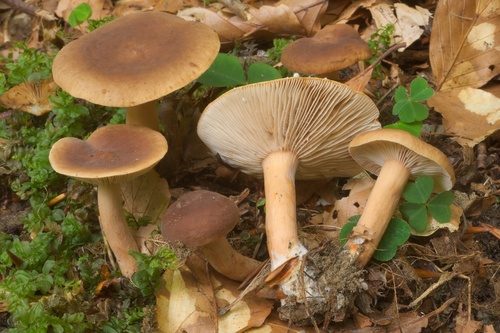
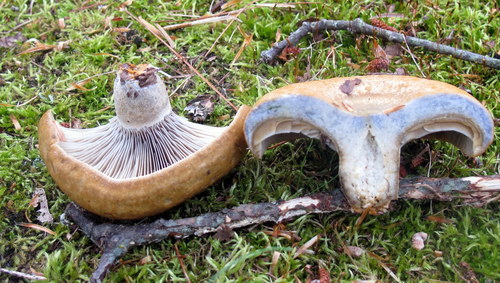
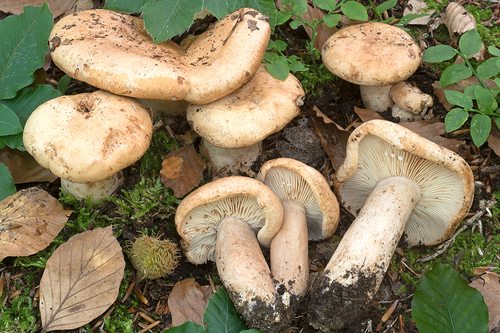
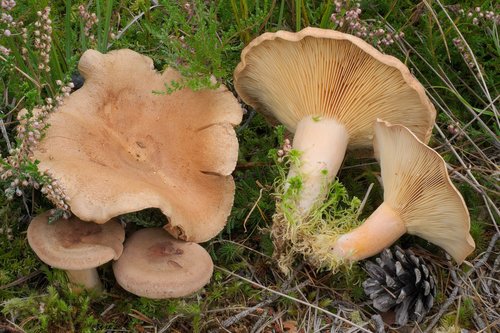
The velvety cap of Lactarius helvus starts out slightly convex (planoconvex) and matures into a funnel-shaped (infundibuliform) form. It measures 4–15 cm (1½–4 in) across, and has a faint zonate (bull's-eye) pattern: it is beige or light grey at the margins and darkens toward the centre. The decurrent gills are cream when young, and darken to ochre-yellow as they age. The flesh is white or beige, and often tinged with pink. The latex (milk) is watery and colourless. The hollow cylindrical stalk is 3–9 cm (1–3½ in) tall and 1–2 cm (½ in) wide. When young, the stalk may be whitish; it can become ochre or pink-tinged, and is sometimes marked with orange-brown spots. The fungus has a highly distinctive smell, most often described as similar to fenugreek, and a mild taste. Some people compare the scent to lovage, celery, liquorice, or a packet of Maggi instant soup. Fruiting bodies grow in groups in woodlands near conifers like Picea and Pinus, as well as the deciduous tree birch (Betula); they are rarely found near beech (Fagus). They grow specifically in wet locations, often in Sphagnum moss, and fruit in late summer and autumn. This species occurs across Europe and Asia. Consumption causes poisoning symptoms that appear within thirty minutes, including nausea, vomiting, vertigo, and chills. The toxic compounds are thought to be sesquiterpenes. A 1949 poisoning event near Leipzig in eastern Germany affected 418 people. The toxins are destroyed by thorough boiling, so after drying, the species is used in small quantities as a spice. The compound responsible for the fungus's distinctive odour is sotolon, which also produces the characteristic scent of fenugreek seed and lovage. Sotolon is also found in molasses, aged sake, white wine, flor sherry, roasted tobacco, and maple syrup.