About Lactarius fallax A.H.Sm. & Hesler
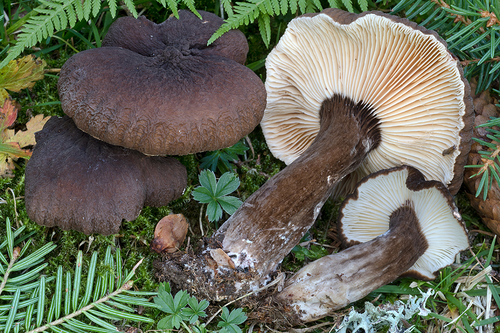
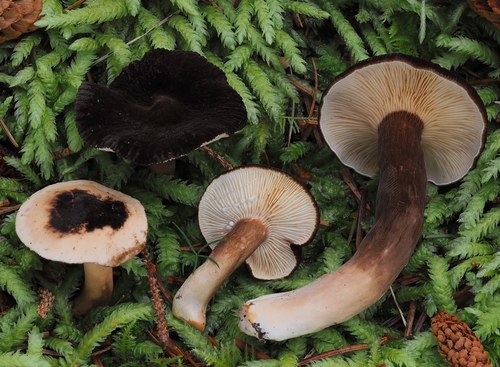
This mushroom species is formally named Lactarius fallax A.H.Sm. & Hesler. Its cap measures 2–9 cm (0.79–3.54 in) wide, starting out convex to nearly flat with a small umbo, and expanding to plane or becoming shallowly depressed; the umbo may or may not remain. The cap margin (edge) is even or scalloped. The cap surface is dry and velvety, finely wrinkled over its center, azonate (without concentric lines), and colored dark sooty brown to blackish. The gills are attached to subdecurrent (running shortly down the stem), narrow, crowded, not forked; they start out white and become creamy buff with age. Gill edges are the same brown as the cap, and slowly stain vinaceous (redwine-colored) when bruised. Several tiers of short lamellulae (gills that do not reach the stem) are interspersed among the full-length gills. The stem is 2.5–8 cm (1.0–3.1 in) long, 5–15 mm (0.2–0.6 in) thick, nearly equal in width along its length, dry, solid, unpolished or velvety, and a paler brown than the cap. The flesh is thin and brittle, and stains pale vinaceous when bruised. The mushroom has no distinctive odor, with a mild or faintly acrid taste. It produces copious white latex when cut that does not change color, and slowly stains flesh and gills vinaceous. Its spore print is yellowish-white. The edibility of Lactarius fallax is unknown. According to David Arora, L. fallax is one of several brown to nearly black milkcaps that are "notable for their beauty, and therefore likely to attract the attention of even the casual collector". A variety, Lactarius fallax var. concolor, is nearly identical to the main species in both appearance and distribution, differing only in that its gill edges are the same color as the gill face. In terms of microscopic characteristics, the spores are spherical, ornamented with warts and ridges that form a partial net-like reticulum, with prominences up to 2 μm high. They are translucent (hyaline), amyloid (absorb iodine when stained with Melzer's reagent), and measure 7.5–10.0 by 7–9.5 μm. The cap cuticle is structured as a trichoderm. The spore-bearing basidia are 38–56 by 10–13 μm, club-shaped, four-spored, and hyaline when mounted in dilute potassium hydroxide (KOH) solution. Abundant cheilocystidia (cystidia on gill edges) have contents that range from dingy yellow to hyaline in KOH. They measure 32–50 by 3–6 μm, and may be spindle-shaped (tapered at both ends), cylindrical, or flexuous (winding side to side). Pleurocystidia (cystidia on the gill face) are filamentous, 2.5–5 μm in diameter, and occur from rarely to scattered. Fruit bodies of L. fallax grow scattered to grouped on the ground, or on very rotten conifer logs in alpine areas under standing conifers; they also grow in spruce forests. They are fairly common, and typically fruit between August and October. The species is distributed in western United States and western Canada, with its northern range extending to Alaska, and its eastern range bounded by the Great Plains. Field observations suggest L. fallax can form ectomycorrhizal associations with Tsuga heterophylla. Hesler and Smith noted that the variety concolor is prevalent under species of Fir.