About Lactarius deterrimus Gröger
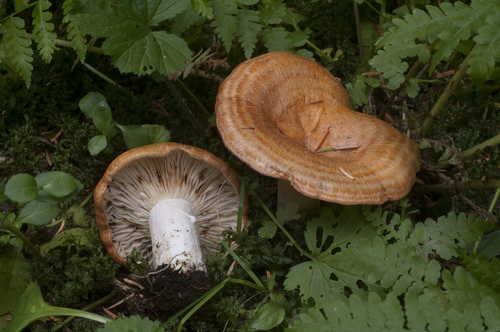
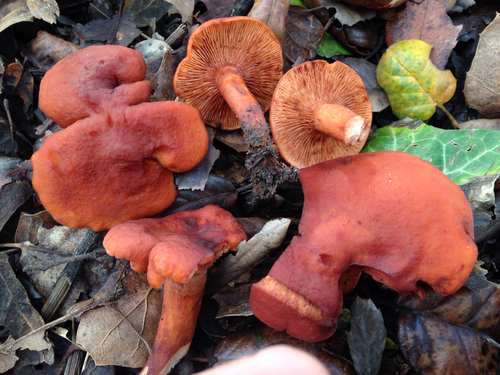
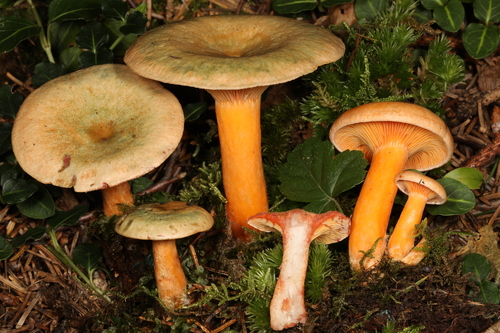
Lactarius deterrimus Gröger has the following macroscopic characteristics. The cap ranges 3 to 10 cm (1 to 4 in) wide, rarely growing up to 12 cm (4+1⁄2 in), and is generally roughly circular in shape. Young caps are convex with curled edges and a depressed center; older caps become flat, funnel-shaped, and remain depressed. The cap surface is hairless, greasy when the weather is moist, and slightly shiny when dry. Cap colour ranges from tangerine to orange-brown, with darker concentric zones near the edges, and fades primarily to yellow-brown with age. In old age, or after exposure to cold or frost, the cap colour shifts more or less to a dirty greenish hue or develops green spots. The dense, curved gills (lamellae) are pale orange to pale ochre, attach at the base of the stipe or run slightly down it, and are brittle. They are mixed with shorter lamellulae (short gills that do not reach the stipe from the cap margin), and sometimes fork near the stipe. In old age or when injured, the gills develop dark red spots that turn grey-green over time. The spore print is pale ochre. The stipe is mostly long and cylindrical, and coloured reddish orange. It measures 4 to 8 cm (1+1⁄2 to 3 in) long, rarely up to 10 cm (4 in), and 1 to 1.5 cm (3⁄8 to 5⁄8 in) wide, with barely noticeable pitting or blotchiness. It is often slightly thickened or swollen at the base and becomes hollow internally. A fluffy circular zone occurs where the gills attach to the stipe. The latex (milk) is initially carrot-red, and changes to maroon within 10 to 30 minutes. The flesh is brittle, pale yellowish, and is often infested with maggots. When cut or injured, the flesh changes colour the same way the milk does: first carrot-red, then maroon, and turning dirty green within hours. Fruit bodies have a harsh, fruit-like scent; the taste is first mild, then becomes slightly resinous-bitter, and is nearly spicy or somewhat astringent. For microscopic characteristics, the spores are round to ellipsoid, measuring 7.5–10 μm long by 6–7.6 μm wide. Their surface ornamentation reaches up to 0.5 μm high, and is made up mostly of warts and short, wide ridges connected by a few fine lines to form an incomplete net (reticulum). The suprahilar area, a distinct defined zone above the spore apiculus, is weakly amyloid. The spore-bearing basidia are four-spored, measuring 45–60 × 9.5–12 μm. They are roughly cylindrical to somewhat club-shaped, and often contain an oil droplet or granular body. The sterigmata are 4.5–5.5 μm long. Thin-walled pleurocystidia are sparse, but somewhat more common near the gill edge. They project out, measuring 45–65 μm long by 5–8 μm wide, and are sometimes smaller near the gill edge. They are nearly spindle-shaped, often straight, or constricted in a string-of-pearls pattern at the apex, and their contents are usually fine and granular. Pseudocystidia are abundant. They are 4–6 μm wide, sometimes project out, but are often shorter than basidioles (early developmental stage basidia). Basidioles are cylindrical to twisted, contain an ochre-coloured substance similar to laticifers, and are almost hyaline (transparent) near their apex. The gill edge is usually sterile and has a few to many cheilocystidia. Thin-walled cheiloleptocystidia are 15–25 μm long by 5–10 μm wide. They are almost club-shaped or irregularly shaped, transparent, and often contain granular material. Cheilomacrocystidia are also thin-walled, measuring 25–50 μm long by 6–8 μm wide. They are slightly spindle-shaped, often have a string-of-pearls-like tip, and their interior is hyaline or granular. Laticifers are abundant and prominent, with ochre-coloured contents. The cap cuticle is an ixocutis, meaning its hyphae are embedded in a jelly-like matrix that can swell heavily and become slimy when exposed to moisture. Lactarius deterrimus is primarily distributed across Europe, and has also been found in parts of Asia including Turkey, India, and Pakistan. Recent molecular research shows that similar-looking species from North America (the United States and Mexico) are not closely related to the European species. In Europe, it is especially common in Northern, North-Eastern, and Central Europe; in the UK, it can be found from July through November. In southern and western Europe, it is common in mountainous areas. In the east, its range extends as far as Russia. Ecologically, Lactarius deterrimus was traditionally thought to have strict mycorrhizal host specificity with Norway spruce. In 2006, it was reported that this fungus can also form arbutoid mycorrhiza with bearberry (Arctostaphylos uva-ursi). Arbutoid mycorrhizal associations are a variant of ectomycorrhiza found in certain Ericaceae plants, defined by the presence of hyphal coils in epidermal cells. The mycorrhiza formed by L. deterrimus on both bearberry and Norway spruce has typical features including a hyphal mantle and a Hartig net. The key difference between the mycorrhizal symbioses on the two hosts is that hyphae penetrate the epidermal cells of bearberry; there are also additional differences in the form of the Hartig net, branching pattern, and colour. While bearberry is known to form mycorrhiza with a wide range of fungi in both field and laboratory experiments, this was the first recorded case of bearberry forming mycorrhiza with a fungus previously considered strictly host-specific. Bearberry may act as a nurse plant to help Norway spruce re-establish in deforested areas. This species is common in spruce-fir, spruce-moorland, and spruce forests and plantations. Along with spruce, it is also common in various European beech, oak, and European hornbeam forests, as well as on forest edges, clearings, clearcut meadows, juniper heathers, and parkland. There are almost no habitats where spruce is common that this fungus does not also occur. It is very common in young spruce forests 10 to 20 years old, where it sometimes grows in large masses along forest path edges. The fungus probably prefers calcareous soil, though it has been found in nearly every soil type, including sand, peat, limestone soils, rankers, and Cambisols. It tolerates both acidic and alkaline conditions, and soils from low-nutrient to relatively high-nutrient. Heavily eutrophic soils are not suitable for its habitat. Fruit bodies grow from late June to November, most commonly from August to October; overwintered specimens can be found on freezing days up to early February. It prefers hills and uplands, but is also not uncommon in lowlands.