About Lactarius deliciosus (L.) Gray
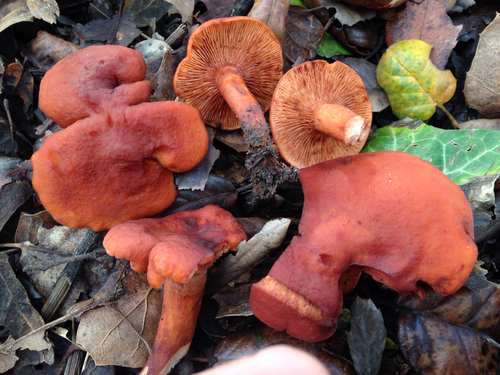
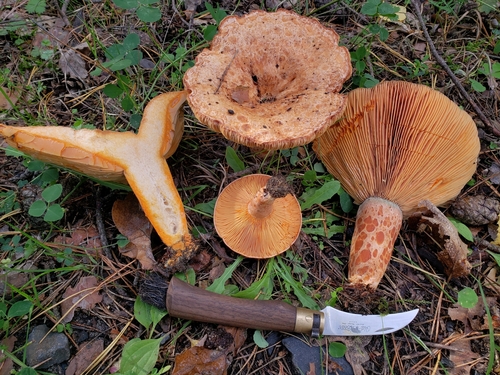
Lactarius deliciosus (L.) Gray, commonly known as the saffron milk cap, has a carrot-orange cap ranging from 3 to 20 centimetres (1 to 8 inches) across. The cap shape ranges from convex to vase-shaped; young specimens have inrolled caps, and the cap surface often features darker orange lines arranged in concentric circles. The cap becomes sticky and viscid when wet, but is most often found dry. This species has crowded decurrent gills and a short, thick orange stipe that is frequently hollow. The stipe measures 2 to 8 cm (1 to 3 inches) long, and 1 to 2.5 cm (1⁄2 to 1 inch) thick. When handled, both the flesh and gills stain a deep green color. Fresh specimens exude an orange-red latex that does not change color, and the spore print of this species is cream-coloured.
In terms of distribution and habitat, Lactarius deliciosus grows under conifers on acidic soils, forming a mycorrhizal relationship with its host tree. It is native to Europe; originally it is native to the southern Pyrenees where it grows under Mediterranean pines, and occurs throughout the Mediterranean basin in Portugal, Bulgaria, Spain, Greece, Italy, Cyprus, France and other nearby areas. It is also found in Argentina, where it is called "níscalo", Chile where it is known as "callampa rosada", and Uruguay, where local names are "hongo delicioso" or "hongo catalán". Large populations of this species grow at high altitude in the Pinus nigra and P. brutia forests of Cyprus's Troodos mountain range, where local people actively hunt the mushrooms, which are valued as a local delicacy. The species is also sold and collected alongside Lactarius deterrimus in Turkey's southwestern İzmir Province and south coastal Antalya Province. DNA analysis of collections from across the world by mycologists Jorinde Nuytinck, Annemieke Verbeken, and Steve Miller has confirmed that L. deliciosus is a distinct European species that differs genetically, morphologically, and ecologically from related populations found in North America or Central America. It has been introduced to Chile, Australia, New Zealand, and South Africa. In introduced ranges, it grows in Pinus radiata plantations. In Australia, popular collecting spots for the species include the area around Macedon in Victoria, Mount Crawford in the Adelaide Hills, the Oberon area in New South Wales, and the pine forests of the Australian Capital Territory; specimens growing in Oberon can reach the size of a dinner plate. Many Australians of Italian, Polish, Ukrainian and other eastern European ancestries living in Victoria and New South Wales travel to collect these mushrooms after autumn rain around Easter. Favoured habitats for the species also include pine plantations and Siberian pine forests.
Lactarius deliciosus is an edible mushroom, though it may have a mild or bitter taste. Its specific epithet "deliciosus", meaning 'delicious', is considered misleading, and may have been assigned because Linnaeus confused it with another species. Mushrooms are collected from August to early October, and are traditionally prepared by salting or pickling. Widespread high consumption of the species may cause urine to turn orange or red. The species is widely collected in the Iberian Peninsula and is used in Spanish cuisine; a common Spanish preparation method calls for lightly washing the whole mushrooms, frying them cap-down in olive oil with a small amount of garlic, then serving them drizzled with raw olive oil and parsley, with only a very small amount of butter recommended for cooking. The mushroom is very popular in Russia, where it is most commonly salted; traditional Russian cuisine preserves this species through salting. Further east and north in Europe, it is a common ingredient in Provençal cuisine. In Poland, where the species is also collected, traditional preparations include frying in butter with cream, or marinating. In Cyprus, saffron milk caps are most often grilled over charcoal, then dressed with olive oil and lemon or bitter orange; they may also be sautéed with onions, or stewed with onions, coriander and red wine. In India, this fungus is one of the ten most widely consumed mushrooms eaten by indigenous tribes of Meghalaya.