About Lactarius chrysorrheus Fr.
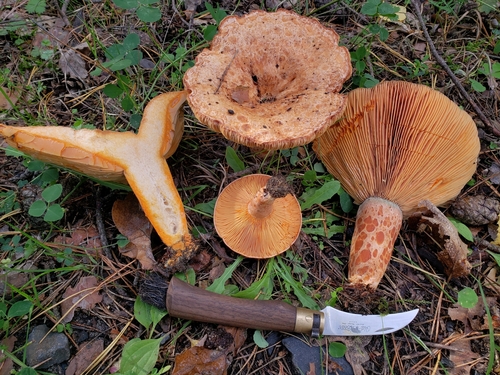
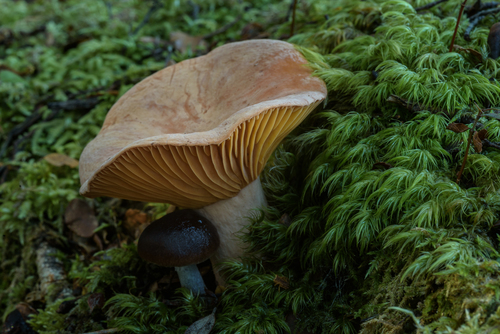
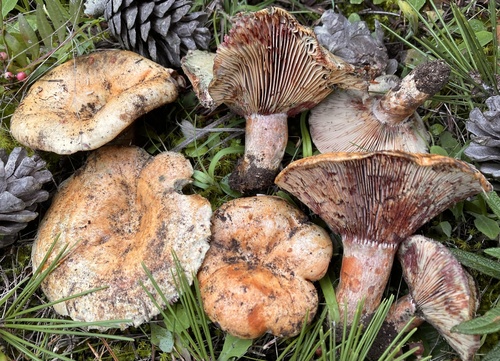
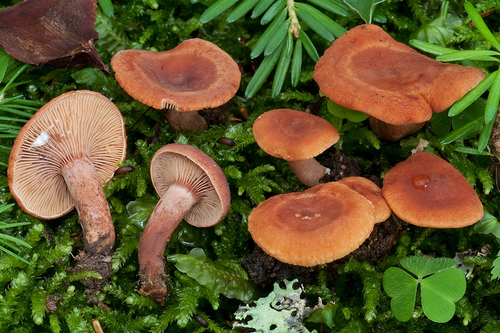
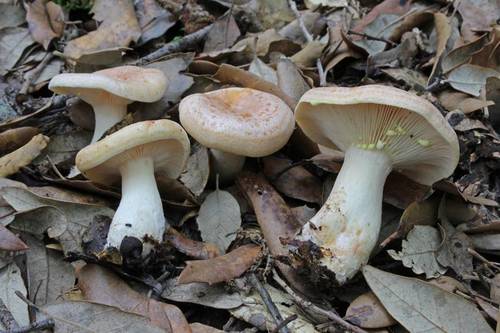
The cap of Lactarius chrysorrheus Fr. measures 3–8 cm (1.2–3.1 in) in diameter. Its colour is pale salmon or rosy, marked with darker markings arranged in rough rings or bands. When young, the cap is convex; it flattens as it matures, and eventually develops a small central depression. The cap edge is often somewhat lobed, the cap surface is smooth, and its margin is hairless. The stipe ranges from whitish to pale buff, and sometimes has a pink flush on its lower half. It is hollow and cylindrical, or has a slightly swollen base. The gills are decurrent, crowded, and have a pinkish buff tinge; they are quite closely spaced when young. They produce a creamy white spore print with a slight salmon tinge. The flesh is white and has a hot taste, and is coloured by the copious amounts of milk the mushroom exudes. This milk is initially white, but turns bright sulphur yellow 5 to 15 seconds after being exposed to air. Many similarly coloured Lactarius species do not produce white milk that turns sulphur yellow. Among the species that do share this trait are Lactarius maculatipes and Lactarius croceus, which grow with hardwoods in the northeastern United States; Lactarius vinaceorufescens is also locally abundant there, growing with both hard and soft woods. None of these three species are found in Britain. Lactarius decipiens appears on the British checklist, but it is smaller than L. chrysorrheus, and grows with hornbeam. Lactarius chrysorrheus fruits in summer and autumn. It is frequent in northern temperate zones of Europe, North America, and also occurs in North Africa. In Britain, it forms mycorrhizal associations with oak trees. This mushroom contains toxins and is considered poisonous, though it has sometimes been incorrectly listed as edible. Consumption of several species of poisonous milkcaps causes predominantly acute gastrointestinal symptoms, which can be severe. The milk of Lactarius chrysorrheus is extremely acrid.