About Lactarius camphoratus (Bull.) Fr.
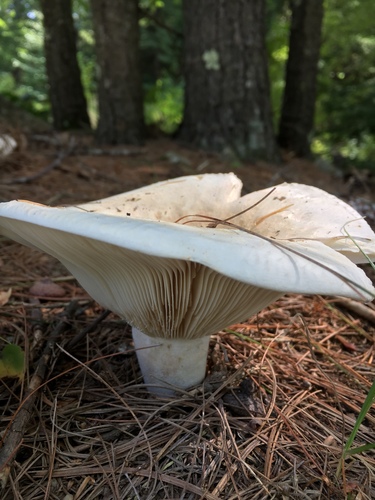
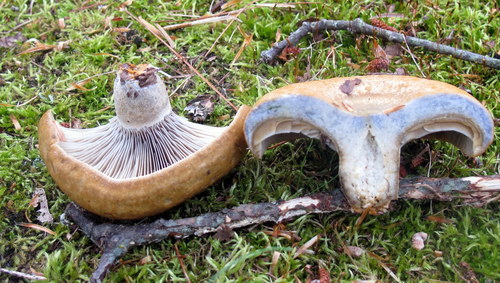
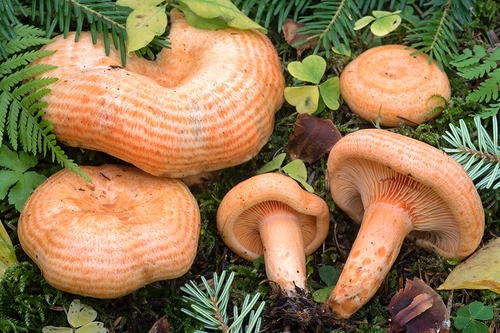
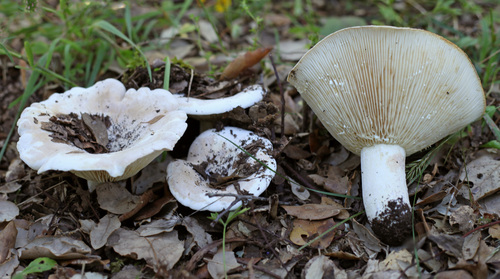
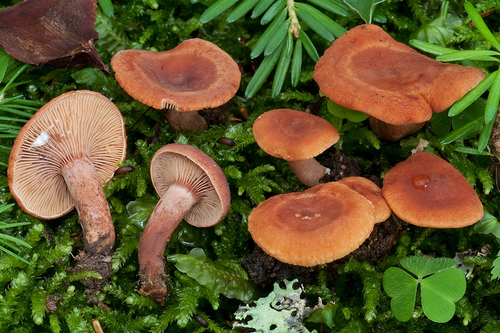
This entry describes the species Lactarius camphoratus (Bull.) Fr., commonly known as candy cap. Candy caps are small to medium-sized mushrooms, with caps ranging 2–7 centimeters in diameter, colored from orange-brown to reddish-brown. Young specimens have broadly convex caps, while older caps become flat to slightly depressed. Their gills are attached to subdecurrent, and the stem grows 3–6 cm long. The entire fruiting body may be firm, or fragile and brittle. Like all members of the genus Lactarius, this mushroom exudes latex when broken: in this species the latex is whitish and watery, often compared to whey or nonfat milk. The latex has little flavor or is slightly sweet, and is never bitter or acrid. This species is most notably characterized by its scent, which has been compared to maple syrup, camphor, curry, fenugreek, burnt sugar, Malt-O-Meal, or Maggi-Würze. The scent is often faint in fresh specimens, but becomes much stronger when the fruiting body is dried. Microscopically, it shares traits typical of the genus Lactarius: round to slightly oval spores with distinct amyloid ornamentation, and abundant sphaerocysts in cap and stem tissue, which are infrequent in gill tissue. When identifying this mushroom, it is easy to mistake other distasteful or toxic species for candy caps, or accidentally mix them into candy cap collections. Those new to mushroom identification may mistake any small brown mushroom (often called LBMs) for candy caps, including the deadly Galerina marginata and its close relatives, which can grow in the same habitat. Candy caps can be separated from non-Lactarius LBMs by their brittle stems, as most other LBMs have more flexible stems. It is recommended that foragers gather candy caps by hand, breaking the fragile stem between their fingers to check this trait; LBMs with cartilaginous stems are easily distinguished this way. Candy caps may also be confused with many small, similarly colored Lactarius species, which range from distasteful to outright toxic depending on the species and amount consumed. Candy caps can be distinguished from other Lactarius by several key traits. First, odor: candy caps have the distinctive sweet scent described above, which other Lactarius species do not have, though other Lactarius may have their own distinct odors. Fresh candy caps may lack a noticeable odor, which reduces the usefulness of this trait for identification. A sweet odor becomes much more obvious if you briefly singe the mushroom flesh with a match or lighter, making this a useful identification trick. Second, taste: the flesh and latex of candy caps are always mild to slightly sweet, with no hint of bitterness or acridity. Note that some similar Lactarius, such as L. luculentus, have subtle bitterness that may not appear for a minute or more after tasting. Third, latex: the latex of candy caps is thin and whey-like, similar to diluted milk. It does not change color, and does not discolor the mushroom flesh. Other Lactarius species have distinctly white or colored latex, which may discolor the mushroom flesh in some species. Fourth, cap: candy caps never have a zonate color pattern on the cap surface, and the cap is never even slightly sticky or viscid. Near the West Coast of North America, candy caps can be found from December through March. Like other Lactarius species, candy caps are generally considered ectotrophic, and L. camphoratus has been identified growing in ectomycorrhizal root tips. Unusually for a mycorrhizal species, the closely related L. rubidus is also commonly found growing directly on decaying conifer wood. All candy cap species associate with a range of tree species. Candy caps are not typically consumed the way most other edible mushrooms are. Due to their strong aromatic quality, they are primarily used as a flavoring, similar to vanilla, saffron, or truffles. They add a flavor and aroma compared to maple syrup or curry to foods, with a much stronger aroma than either of these seasonings. They are unique among edible mushrooms for their common use in sweet dessert foods, such as cookies and ice cream. They are also sometimes used to flavor savory dishes that are traditionally served with sweet accompaniments, such as pork, and may be substituted for curry seasoning. They are almost always used dried, as their characteristic aroma intensifies greatly when dried. To use as a flavoring, dried candy caps are either ground into powder or infused into a liquid ingredient for the dish, for example by steeping them in hot milk the way whole vanilla beans are used. Because of these culinary properties, candy caps are highly sought after by many chefs. The closely related L. rubidus is commercially harvested and sold in California, while L. camphoratus is commercially harvested and sold in the United Kingdom and Yunnan, China. One source, Marchand, notes that some people add L. camphoratus to pipe tobacco blends.