About Lactarius blennius (Fr.) Fr.
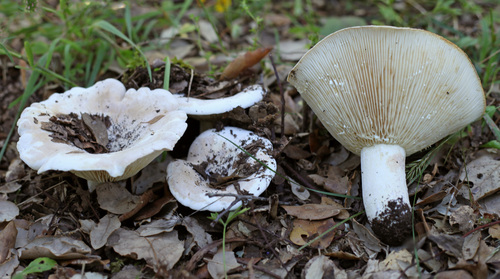
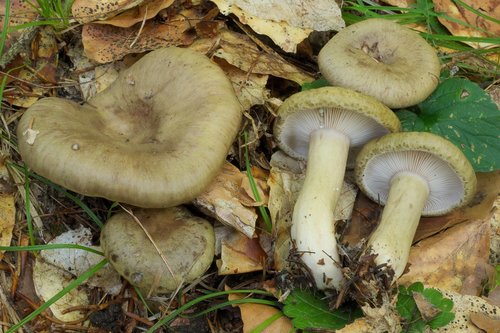
The scientific name of this species is Lactarius blennius (Fr.) Fr. Lactarius blennius has an initially flattened convex cap that measures 4–10 cm (1.6–4 in) across, and becomes depressed in the center as it matures. The cap ranges in colour from pale olive to greenish grey, sometimes dull green or pale grey-sepia, with darker blotches arranged in concentric bands, though overall colour can vary greatly. Heavily spotted specimens are known to occur, and a very brown specimen similar to Lactarius circellatus has been recorded in Scotland. When moist, the cap is very slimy, and its margin curves inwards. The stem is paler than the cap, also very slimy, and measures 4–5 cm (1.6–2 in) tall by 1–1.7 cm (0.4–0.7 in) thick, tapering slightly toward the base. Both the flesh and young gills are whitish; as they age, the gills become creamy or pale buff. The crowded gills turn brownish-grey when wounded. In terms of stem attachment, gills are either slightly decurrent (running a short way down the stem) or adnate (attached to the stem by their full depth). The mushroom produces abundant white milk that dries grey. Spore prints from this species are creamy; spores are elliptical, with low warts connected by ridges and a small number of cross-connections, and measure 6–9 by 5.5–7 μm. Lactarius blennius is very common, found growing in broad-leaved woodland, and strongly favours beech, most commonly associating with Fagus sylvatica (European Beech). It has also been observed growing in association with oak species. It forms ectomycorrhizal associations with trees, and can grow across a wide range of subsoil types, though it is most typical of acidic soil. It fruits between late summer and late autumn, and is native to Europe. Its distribution matches the distribution of beech, and it is counted among the one hundred most common mushroom species in the British Isles. It has also been recorded in Sweden, France, Italy, and Poland. Regarding uses, mycologist Roger Phillips states that L. blennius is edible when cooked, but is not recommended for eating; other sources classify the species as inedible or even poisonous. Its milk has a very hot, acrid taste. This species has been studied in chemical research. Lactarane derivatives called "blennins" have been extracted from L. blennius, including the lactone blennin D, and blennin A, which was first isolated from this species. Lactaranes are named for their frequent occurrence in Lactarius species. Blennins have been identified as potentially useful: blennin A, a lactarane-type sesquiterpene, acts as an anti-inflammatory, with a strong inhibitory effect on leukotriene C4 biosynthesis. L. blennius can also be processed to produce a green pigment called blennione.