About Lactarius alnicola A.H.Sm.
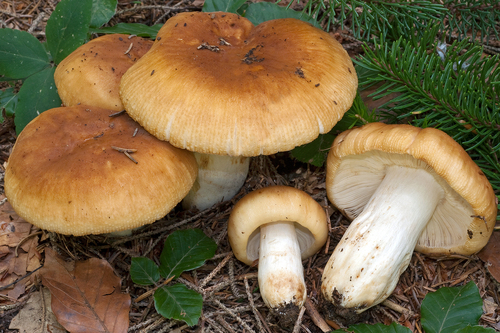
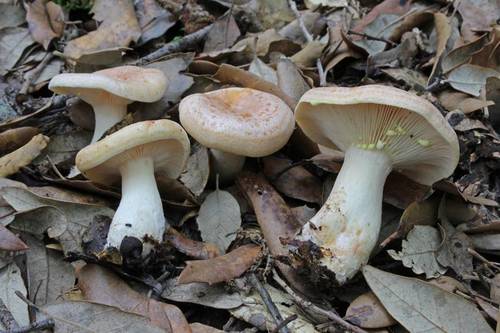
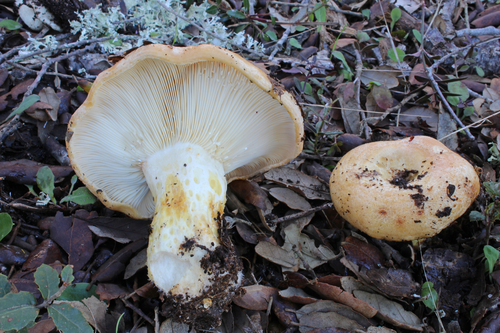
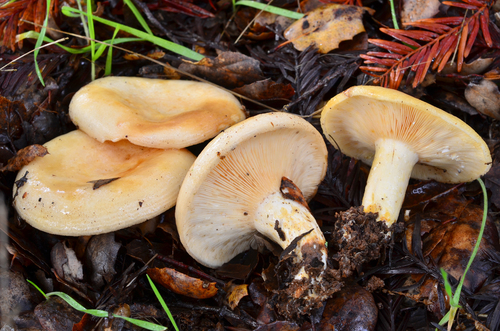
Lactarius alnicola A.H.Sm. has a cap 6 to 20 centimeters (2+1⁄2 to 8 inches) wide that starts convex, and becomes depressed to funnel-shaped when mature. The cap margin is initially rolled inward, and becomes uplifted as the cap expands. The cap surface ranges from sticky to slimy, and has matted hairs near the margin under the slimy or sticky layer. The cap surface is yellow-ochre, sometimes marked with concentric bands of lighter and darker shades, and becomes paler near the margin. The gills range from adnate (squarely attached to the stem) to decurrent (attached to and running down the length of the stem), are narrow, and crowded closely together. Forked near the stem, the gills are initially whitish before turning pale ochraceous-buff. Many lamellulae—small gills that do not extend completely to the stem—are present. The stem is 3 to 6 centimeters (1+1⁄4 to 2+1⁄4 inches) long and 2 to 3 centimeters (3⁄4 to 1+1⁄4 inches) thick, is nearly equal in width throughout or tapered downward, dry, hard, coarsely pitted, and ranges from whitish to cream yellowish. It starts solid, and becomes hollow with age. The flesh is thick, hard, whitish, and slowly stains pale yellow after the mushroom is cut open. It has no distinctive odor, and an immediately acrid taste. The latex is sparse, white when exposed to air, and either does not change color or changes very slowly to yellow. It stains cut flesh yellow, and tastes acrid. According to mycologist David Arora, the population of this species that grows with oaks in central and southern California has a more latent acrid taste. The spore print can vary slightly in color: thin deposits are white, while thick deposits are more yellow. The mushroom is considered inedible due to its intensely peppery taste. Lactarius alnicola is an ectomycorrhizal species that forms a mutualistic association with certain plant species. In this association, the fungus's hyphae penetrate large volumes of soil to obtain scarce elements, especially phosphorus—often a limiting nutrient for plant growth—that they pass to the plant, in exchange for metabolic products from the plant's photosynthesis. Ectomycorrhizae formed by this fungus in association with Picea engelmannii have been found to contain lactifers (latex-producing cells) and pigments similar to those in the mushroom's fruit body. Fruit bodies grow in groups on the ground under alders and conifers, and usually appear between July and October. It is a fairly common species in the western United States and Baja California. Additional collection locations in Mexico include Veracruz, Villarreal, and Tapia. A population in central and southern California is known to associate with oak trees. In the Rocky Mountains, it associates with subalpine Engelmann Spruce (Picea engelmannii), while at lower elevations it is commonly found with white spruce (Picea glauca). It is also known to associate with Ponderosa Pine (Pinus ponderosa) and Douglas-fir (genus Pseudotsuga). The mushroom has also been collected from Bageshwar, Uttarakhand, India.