About Lachnolaimus maximus (Walbaum, 1792)
Etymology of Common Name
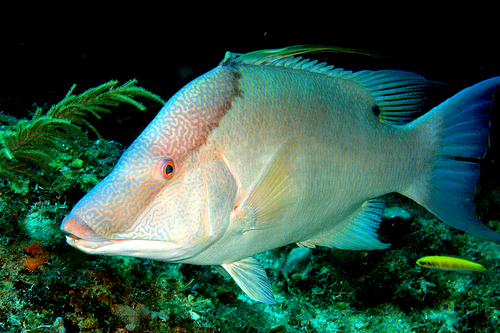
The hogfish, Lachnolaimus maximus, has a very elongated snout that it uses to search for crustaceans buried in sediment. Its long "pig-like" snout and rooting behavior are what give the species its common name.
Male Sexual Dimorphism Marker
A prominent black spot located behind the pectoral fins distinguishes males from females.
Dorsal Fin Structure
The dorsal fin is usually made up of three or four long dorsal spines, followed by a series of shorter dorsal spines.
Maximum Size and Weight
Hogfish can reach a maximum total length of 90 cm (35 in), and a maximum weight of around 11 kg (24 lb).
Female and Juvenile Coloration
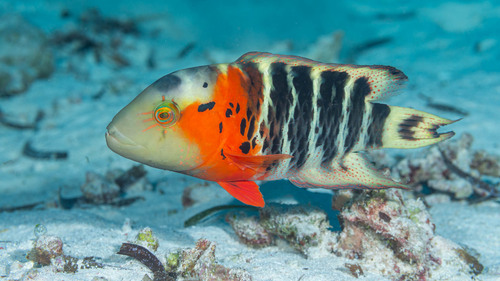
Females and juvenile hogfish are typically pale gray, brown, or reddish-brown, with a paler underside and no distinct body patterns.
Male Coloration
Males can be identified by a deep, dark band that stretches from the snout to the first dorsal spine, as well as a lateral black spot behind the pectoral fins.
Camouflage Ability
Hogfish can use active camouflage aided by dermal photoreception, a sensory ability that lets them detect light through their skin.
Dermal Photoreception Mechanism
Specialized cells that contain opsins, located beneath chromatophores, allow hogfish to detect changes in ambient light.