About Lachnagrostis billardierei (R.Br.) Trin.
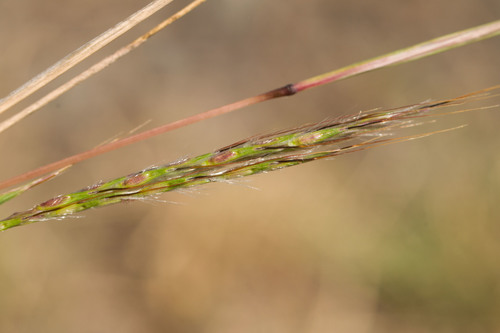
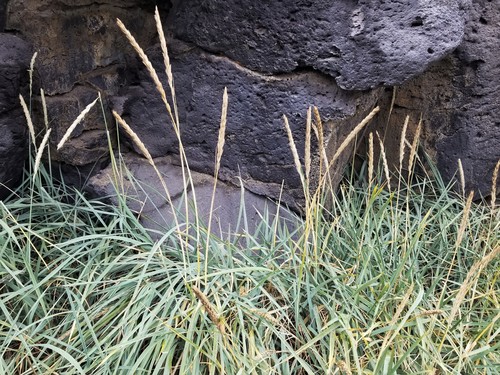
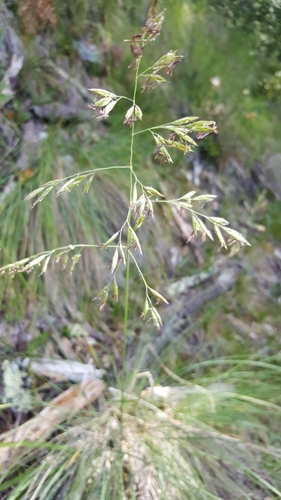
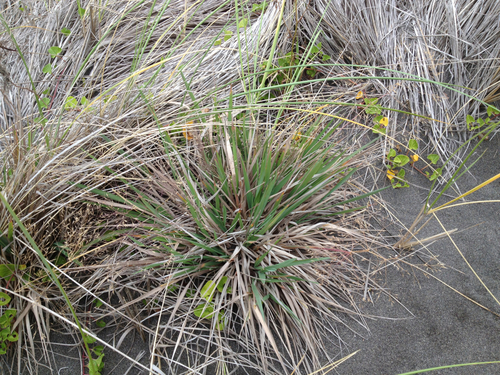
Lachnagrostis billardierei (previously referenced as Agrostis billardierei) is a tufted perennial grass. It grows to around 50 cm in height, and has glaucous to bluish-green leaves. It forms circular tufts of leaf blades and produces straw-coloured flowers. Its seeds are dispersed by wind.
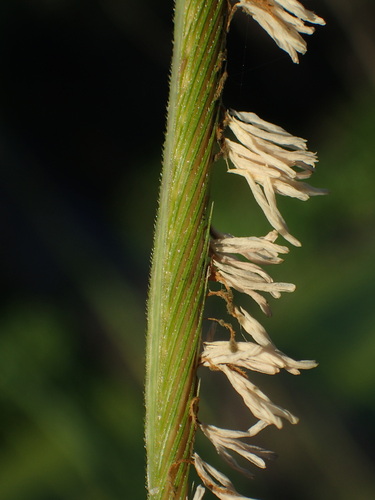
In New Zealand, this species can be confused with two other nationally endemic coastal Lachnagrostis species: L. pilosa subsp. pilosa and L. tenuis. L. billardierei can be told apart from L. pilosa subsp. pilosa by its hairless lemmas. Compared to L. tenuis, the most similar species to L. billardierei, L. billardierei has wider, flat leaf blades that measure 2.5–10 mm wide, and longer spikelets that measure 4–6 mm; by contrast, L. tenuis has inrolled leaves 0.3–0.9 mm wide and spikelets 3–5 mm long.
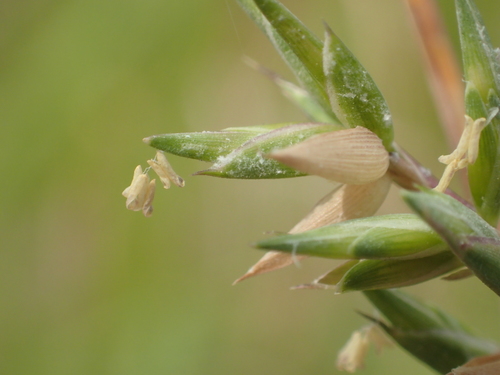
Two subspecies of L. billardierei are recognised, distinguished by awn length: in L. b. subsp. billardierei, awns are longer than 3.5 mm and longer than the glumes; in L. b. subsp. tenuiseta (common name small-awned blown-grass), awns are shorter than 2 mm and are not or hardly longer than the glumes.
The main distribution of L. billardierei is south-eastern Australia and New Zealand, with additional recorded occurrences in the Warren IBRA bioregion of south-western Western Australia. L. b. subsp. billardierei occurs in Tasmania, New South Wales, Victoria, and South Australia. L. b. subsp. tenuiseta was once thought to be endemic to the east coast of Tasmania and Whitemark Island, but has now been identified from three herbarium specimens collected in New Zealand.
L. billardierei is primarily a coastal species, with only a small number of inland records, mostly from Australia. Its coastal habitats include sand dunes, cobble and boulder beaches, cliff faces, edges of coastal lagoons and ponds, and free-draining estuarine river banks. In New Zealand, it occasionally grows well inland on limestone or calcareous sandstone bluffs.