About Laburnum anagyroides Medik.
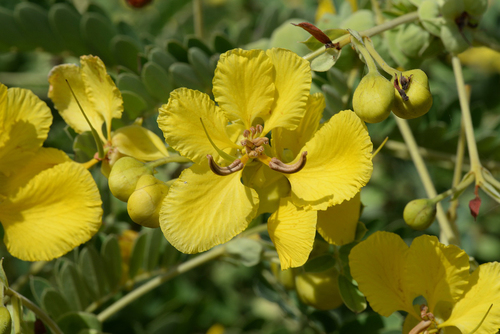
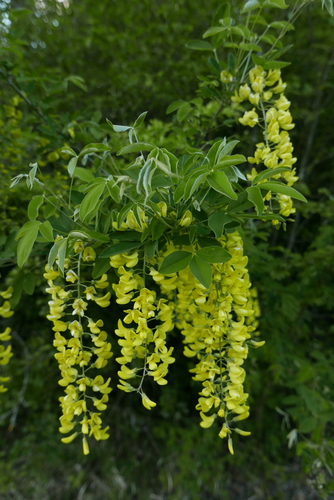
Laburnum anagyroides Medik. is a small deciduous tree or large shrub that grows up to 7 metres (23 ft) tall. It has smooth bark, dark green spreading branches, and pendulous, pubescent twigs. Its leaves are generally trifoliate and oval, with long petioles; they are smooth on the upper side and hairy on the underside. This species flowers during May and June, blooming in late spring with pea-like, yellow flowers that are densely packed into pendulous racemes 10–25 cm (4–10 in) long. The golden yellow flowers are sweet scented, and typically bloom in May. Its fruit are legume pods that hold large numbers of black seeds, which contain cytisine. Cytisine is an alkaloid that is somewhat poisonous to humans, goats, and horses, especially when the seeds are not ripe. Some wild animals including hares and deer can feed on the seeds without any issues, and because of this, the plant is considered to have magic properties in some regions. The wood of Laburnum anagyroides is hard and heavy, with a yellow/brown colour. It is ideal for making posts, for woodturning, and as fuel. In the past, and today for historic re-enactments, it was used to make bows. The tree is also called false ebony, because wood from very old specimens can be used in place of ebony. Cytisine, a substance obtained from this plant, is used as a medicine for smoking cessation. Laburnum anagyroides is cultivated as an ornamental tree. The most common ornamental plant in the Laburnum genus is a hybrid between this species and Laburnum alpinum, which is Laburnum × watereri.