About Kunzea serotina de Lange & Toelken
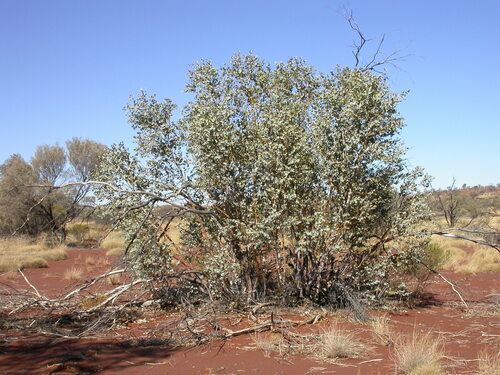
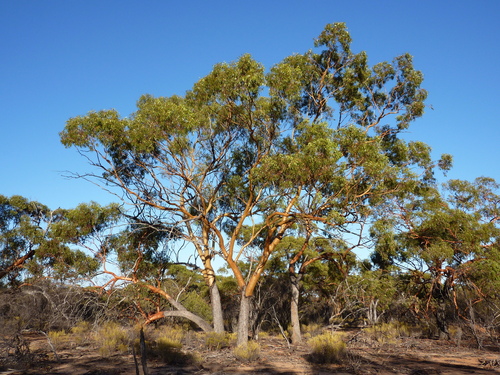
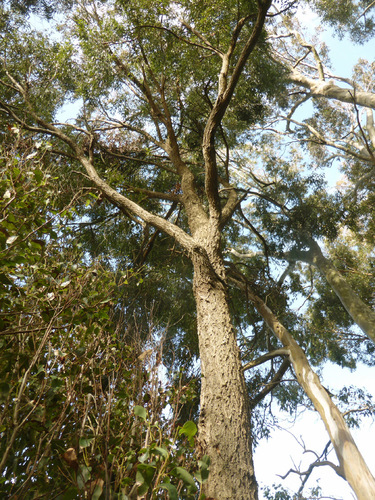
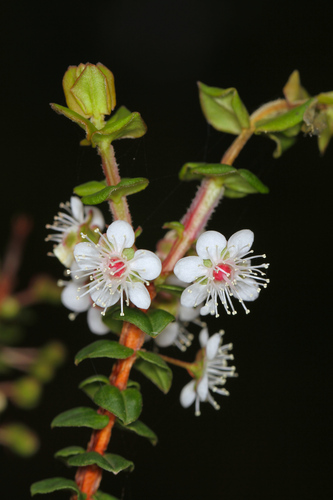
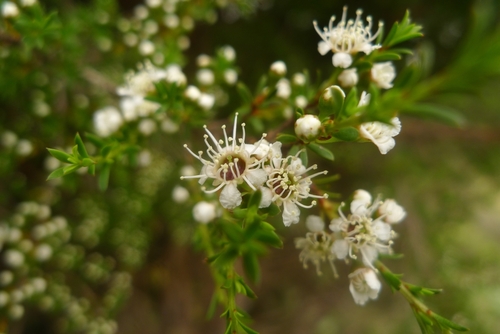
Kunzea serotina de Lange & Toelken is an erect tree or shrub with fastigiate branches that form a pyramidal canopy. Growth habit may vary in older trees growing in stable environments. This species usually has a single trunk growing from the base, though less commonly it may have 2 to 3 trunks. The base is covered by a protective outer layer, and the rest of the trunk is covered in bark made of dead cambium tissue. The bark of K. serotina is greyish-white to pinkish white, and develops cracks that enlarge and become more crumpled as the bark ages, forming a secondary bark layer. Old bark matches the colour of new bark but has more cracks and crumples, and its upper surface becomes loose before peeling off. Numerous branches grow at or close to the trunk base; these branches are short and stout, with fastigiate branching that produces numerous leafy branchlets. Each branchlet contains a brachyblast and ends in a curled apex. Vegetative buds are not clearly visible, as they are hidden by foliage. They measure 0.2-0.5mm in diameter, are covered by a yellow-brown to red-brown, ovate-shaped bud scale. Bud scales have a midrib supporting the upper half and a long cuspidate tip, lack lateral veins and an oil gland, and have a ciliate keel apex. New leaves and shoots are red-green, with pale-green interspersed through the red or bright green leaf colour. Leaf laminae of new growth measure (0.8–) 5.2 (–9) × (0.6–) 0.8 (–1.2) mm and have a narrow oval shape. Mature leaves are dark glossy green or bronze green with red leaf margins and bases; their laminae measure (2.0–) 3.7 (–6.3) × (0.8–) 1.1 (–1.8) mm, are narrow oval shaped, hairless, and have a smooth surface. Flowering occurs from November to May, with peak flowering in January and February. Inflorescences are compact and corymbiform, hold (1–3–) 8 (–12) flowers, and reach up to 25mm in length. Inflorescences form at the tips of extending branchlets with active vegetative growth, and do not produce male-only flowers. Deciduous foliose pherophylls measure 0.9–25 mm in length, have a rounded tip, and taper toward the base. The hypanthium is bell-shaped, measures (1.6–) 2.0 (–3.4) × (1.6–) 1.9 (–3.5) mm, has a free portion 0.4 – 0.8 mm long, and is dark green or red-brown. Flowers have a diameter of (2.8–) 5.2 (–8.8) mm. Petals are white flushed with pink, broadly ovate, measure 1.4 – 1.6 (–2.0) × 1.2 – 1.6 (–2.0) mm, and contain yellow oil glands. Anthers measure 0.04 – 0.06 × 0.02 × 0.04 mm, have an orange connective gland flushed rose when fresh. Pollen grains measure (11.1–) 12.4 (–13.7) μm. The ovary has 3-4 (–5) locules. The style is white, 0.6 -1.2 mm long, and the stigma has a compact, wider, flat head. Fruits are short and sometimes cuplar, and measure (1.2–) 2.1 (–3.0) × (1.2–) 2.1 (–3.4) mm. Seeds are orange-brown to dark brown, narrowly rectangular, and narrow at the ends. Kunzea is an Australasian genus endemic to Australia and New Zealand. Kunzea species are found in the North and South Islands of New Zealand, Western Australia, and Australia’s Great Barrier Island. The Kunzea ericoides complex includes 10 species endemic to New Zealand, seven of which were first described by Peter James de Lange. Kunzea serotina is one of these seven, and is endemic to the North and South Islands of New Zealand. It is a New Zealand native tree or shrub restricted to New Zealand, and does not occur in Australia. Within New Zealand, K. serotina is restricted to the North and South Islands. It was first recorded from the Makaroro River, eastern Ruahine Range. In the North Island, it is found in the Paeoa Range, Mt. Tarawera, Kaingaroa, Central Volcanic Plateau, and the Northern Aorangi Range. It is abundant northeast of the Rangitaiki River, where it grows between flat and upland podocarp forest. In the South Island, it was first recorded from Marlborough. It grows throughout Canterbury from northern to eastern Canterbury, and extends south to Eastern Central Otago, growing along mountain ranges and as remnant populations on the Canterbury plains. In northern South Island, it occurs east of the upper Wairau, west of Karamea, in the Wangapeka Valley, and around Nelson lakes. Its distribution extends south through East Canterbury along the mountain ranges through the upper Hurunui, mainly the Hanmer area, and as far south as Sumner. Further south across the Canterbury Plains, remnant populations of K. serotina occur at Lake Wānaka, the town of Lake Hāwea, and in Eastern Central Otago in the Clutha River catchment and Nenthorn. Members of the Kunzea ericoides complex including K. serotina are tall shrubs or trees common across New Zealand, and they often grow in areas where native forest was previously removed, and readily invade pasture land. They establish easily and often become the dominant vegetation in these areas. K. serotina grows mostly near inland mountain ranges, and prefers areas with seasonal frosting. It can be found growing on steep mountain slopes down to rivers and lakes, in tussock grassland, and above the tree line on mountain tops. It is abundant on rocky, fragment-rich soils that are prone to frequent flooding. Unlike other Kunzea species in the K. ericoides complex, which flower in early and late spring, K. serotina begins flowering in late spring (November), with peak flowering in mid-summer (January to February). This species’ specific epithet, serotina, refers to its later flowering time. Fruiting occurs from January to December. Seeds can germinate in a wide range of soil conditions, and can remain viable for up to five months under dry conditions. Germination rate depends on the conditions where the seed is dispersed: seeds dispersed under a moss cover germinate slowly, while seeds dispersed onto bare uncovered soil germinate rapidly. K. serotina is a fast growing but short-lived tree or shrub, with a maximum lifespan of 80 to 150 years. Juvenile K. serotina takes approximately seven years, less than ten, to reach reproductive maturity, when the plant is typically around 1.5m tall. Over its lifespan, the plant will grow to around 15m tall, with a trunk diameter up to around 60 cm. K. serotina builds up a large seed bank on the soil surface beneath the plant; seeds in this seed bank wait to be dispersed by rainwater runoff, or germinate directly if conditions are suitable. Seeds of K. serotina are not adapted for long-distance dispersal, relying entirely on rainfall runoff for movement. To compensate for its limited dispersal ability, seeds can remain viable for up to five months or longer when kept dry.