About Kunzea parvifolia Schauer
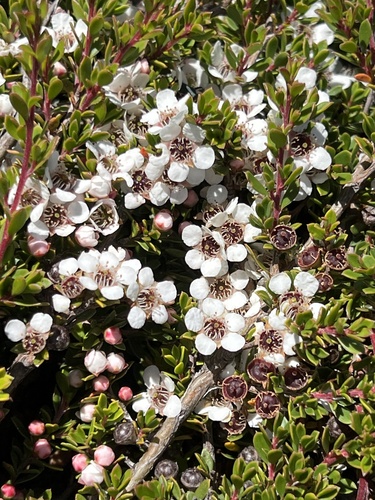
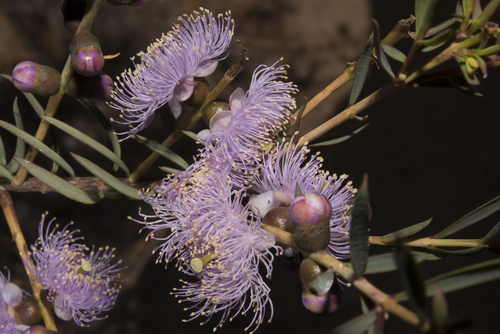
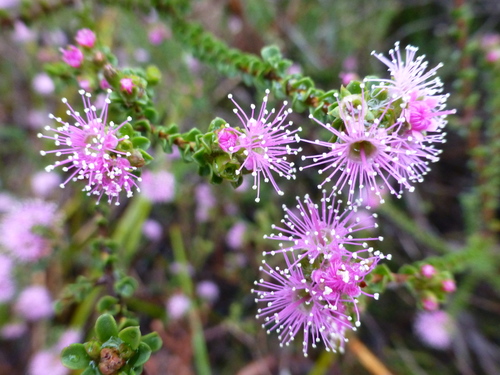
Kunzea parvifolia is a wiry shrub that typically grows to 0.5–1.5 metres (2–5 feet) in height. Its young branches are covered in soft hairs. The leaves are linear to narrow lance-shaped, more or less pressed against the stem. They measure 1–4 mm (0.04–0.2 in) long, about 1 mm (0.04 in) wide, with a petiole less than 1 mm (0.04 in) long, and are covered in soft hairs when young. Flowers are arranged in clusters of mostly three to eight at the ends of branches. The floral cup is 1.5–2.5 mm (0.06–0.1 in) long and more or less glabrous. At the base of each flower there are egg-shaped bracts 2.5–3.5 mm (0.098–0.14 in) long, about 1 mm (0.04 in) wide, plus paired bracteoles. The sepal lobes are triangular to egg-shaped, about 1.5 mm (0.06 in) long, with a pointed tip. Petals range from pink to mauve, rarely white, and are egg-shaped to almost round, about 2 mm (0.08 in) long. There are 30 to 40 stamens, each 2–3.5 mm (0.08–0.1 in) long, and the style is 2.5–3.5 mm (0.098–0.14 in) long. Flowering occurs mostly in October and November. The fruit is an urn-shaped capsule that is about 2 mm (0.08 in) long and wide. This species of kunzea grows in heath and forest habitat. It occurs in eastern New South Wales south from Torrington, and in Victoria, where it is found mainly in the north-east with isolated locations further west.