About Kunzea ericoides (A.Rich.) J.Thomps.
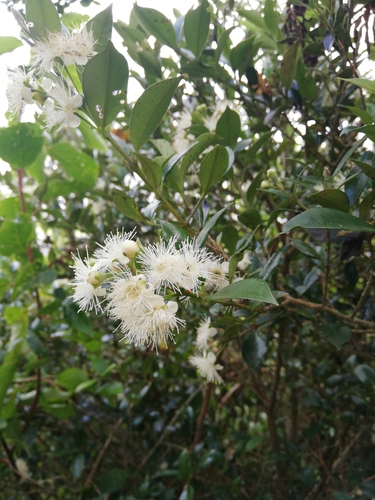
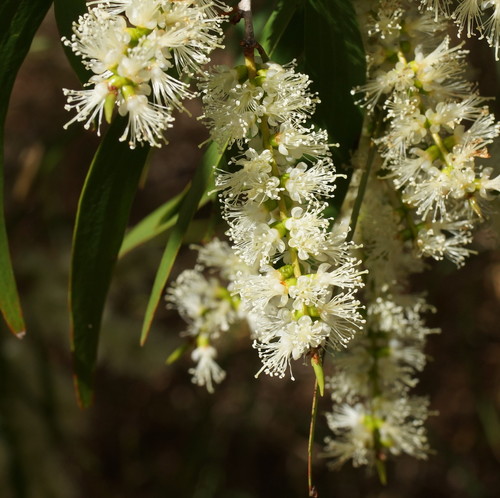
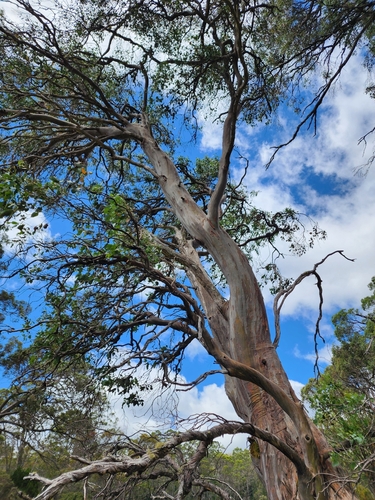
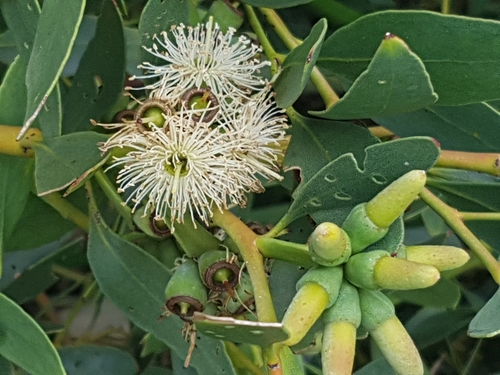
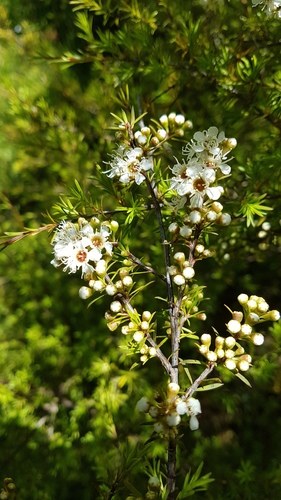
Kunzea ericoides (A.Rich.) J.Thomps., commonly known as kānuka (it was mostly called mānuka until the 1930s), is a spreading shrub or tree that sometimes reaches a height of 18 meters (60 feet). It has bark that peels in long strips, and its young branches tend to droop. Its leaves vary in shape from linear to narrow elliptic or lance-shaped, measuring 6.5–25 mm (0.3–1 in) long and 1–5 mm (0.04–0.2 in) wide, with a petiole up to 1 mm (0.04 in) long. The flowers are white or pale pink, and grow in crowded clusters on side branches or in the axils of upper leaves. The floral cup is covered in soft, downy hairs, and sits on a pedicel 3–6 mm (0.1–0.2 in) long. There are five triangular sepals about 1 mm (0.04 in) long, five petals about 2 mm (0.08 in) long, and up to 25 stamens that measure 1–4 mm (0.04–0.2 in), most of which are longer than the petals. Flowering occurs between October and February, and is followed by a cup-shaped capsule fruit that is 2–4 mm (0.08–0.2 in) long and wide. The capsule usually opens to release its seeds when mature. Kunzea ericoides is very similar to the Australian endemic species K. leptospermoides and K. peduncularis, which were formerly classified as part of K. ericoides. This updated classification for K. ericoides follows the publication of "A revision of the New Zealand Kunzea ericoides (Myrtaceae) complex" by New Zealand botanist Peter de Lange. Kunzea ericoides sensu stricto is only known from the north of New Zealand's South Island, found north of the Buller and Wairau Rivers, and is most common near Nelson. It mostly grows in shrubland and forest in coastal and lowland areas, and rarely grows in subalpine shrubland. Members of the broader kānuka complex are found throughout New Zealand, ranging from the Three Kings Islands and Aotea (Great Barrier Island), from Te Paki on the Aupōuri Peninsula at the northern tip of the North Island, south to Dunedin and Central Otago in the South Island, and Stewart Island. Within this range, kānuka is widespread, growing from coastal scrub and sand dunes (where it may form a distinct forest type) through lowland and montane forest, with one member of the complex reaching elevations of 2000 metres above sea level. Kānuka often colonizes land that is recovering after a fire, and is a critical part of the natural recovery of agricultural areas and open disturbed ground back to forest. With its small but abundant flowers, it can turn an entire hillside white, giving an appearance almost like snow cover. The wood of kānuka is very hard; although it is not durable when in contact with the ground, it is used for wharf piles and tool handles. It is particularly popular as firewood, and burns with a great amount of heat. Kākāriki parakeets (genus Cyanoramphus) use the leaves and bark of kānuka and the related mānuka tea trees to remove parasites. Aside from ingesting the plant material, the parakeets chew it, mix it with preen gland oil, and apply the mixture to their feathers. Mānuka and kānuka are superficially similar and are often confused with one another. The simplest way to tell them apart is by touching the foliage: kānuka leaves are soft, while mānuka leaves are prickly. K. ericoides may grow in the understory of certain rimu/nothofagus forests in the South Island. Typical associated understory species include crown fern (Lomaria discolor) and Cyathodes fasciculata.