About Kunzea baxteri (Klotzsch) Schauer
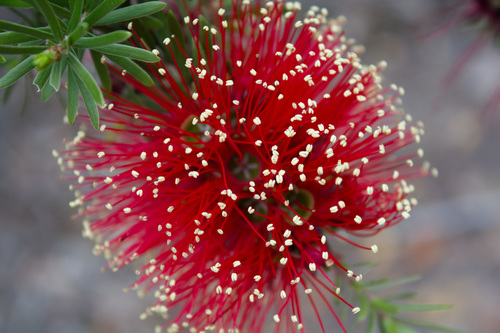
Kunzea baxteri is a spreading shrub that typically grows to a height of 1 to 3 metres (3 to 10 feet), and its branches are more or less hairy. Its leaves are arranged alternately, attached to stems by a 1–2 mm (0.04–0.08 in) long petiole. The leaf blade is usually 14–18 mm (0.6–0.7 in) long, 2.5–3.5 mm (0.098–0.14 in) wide, oblong to elliptic in shape, with hairs along its edges. Flowers are arranged in large, profuse, conspicuous bottlebrush-like clusters that grow up to 10 cm (4 in) long and 6 cm (2 in) wide. Clusters usually hold between 16 and 30 flowers, and form on the ends of branches that continue to grow throughout the flowering period. Leaf-like bracts 5–9 mm (0.2–0.4 in) long and 2–3 mm (0.08–0.1 in) wide are present at the base of each flower, and fall off as the flowers open. The hypanthium is 7–9 mm (0.3–0.4 in) long and hairy on its outer surface. There are five hairy, linear to lance-shaped sepals 4.5–6 mm (0.18–0.24 in) long that remain on the plant as the fruit matures. The five petals are deep red, round to egg-shaped (with the narrower end oriented toward the base), and 3.5–5 mm (0.1–0.2 in) long. Around each flower there are between 40 and 50 bright red stamens, 19–24 mm (0.7–0.9 in) long—four or five times as long as the petals. Flowering is most prolific from July to September, but often occurs as late as March, depending on rainfall. The fruit is a cup-shaped or urn-shaped capsule 8–10 mm (0.3–0.4 in) long, with the erect sepals still attached. Unlike the fruit of many other species in the Myrtaceae, this fruit releases its seeds when mature. Key features that distinguish this species from other Myrtaceae are its red flowers, persistent sepals, and deciduous fruit that releases seeds when mature. Its oblong leaves and narrow sepals distinguish it from Kunzea pulchella, another red-flowered species in the same genus. Kunzea baxteri grows in coarse sandy soil or laterite, often near granite outcrops in heath, scrub, or woodland. It occurs from the coast inland to around 100 km (60 mi) in the Esperance Plains, Jarrah Forest, Mallee, and Swan Coastal Plain biogeographic regions. Scarlet kunzea is pollinated by honeyeaters and mammals, which are attracted to its large red flowers. This kunzea has been grown in gardens for many years. It grows best in climates with dry summers and wet winters, but is adaptable to more humid regions and areas with moderate frosts. It requires a sunny or partly-shaded location with well-drained soil, and is often grown from cuttings grafted onto Kunzea ambigua rootstock.