About Kunzea ambigua (Sm.) Druce
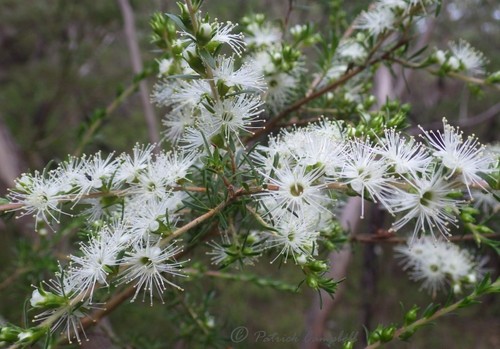
Kunzea ambigua is an erect shrub that typically grows 2 to 4 meters (6 feet 7 inches to 13 feet 1 inch) tall, with young stems covered in shaggy hairs. Its leaves are arranged alternately, shaped linear to narrowly lanceolate, measuring 4 to 12 millimeters (0.16 to 0.47 inches) long and 1.0 to 1.5 millimeters (0.039 to 0.059 inches) wide, borne on a petiole roughly 0.5 millimeters (0.020 inches) long. The flowers are white, more or less stalkless, and crowded on leafy side branches or in the axils of upper leaves. The sepals are narrowly triangular, 1.5 to 2.0 millimeters (0.059 to 0.079 inches) long, and the petals are the same length; the stamens are 3 to 5 millimeters (0.12 to 0.20 inches) long. The ovary usually has three locules, and the style is 5 millimeters (0.20 inches) long. Flowering occurs mainly from October to January. The fruit is dehiscent, 2.5 to 3.5 millimeters (0.098 to 0.138 inches) long and 3 to 4 millimeters (0.12 to 0.16 inches) in diameter.
In terms of distribution and habitat, Kunzea ambigua occurs from northeastern New South Wales (where it has been recorded in the Grand High Tops of Warrumbungle National Park) through Victoria and into Tasmania. It grows in sandy soils in coastal or near-coastal regions. It is a very common dry forest shrub in the Sydney region, and regenerates in disturbed or cleared areas. It grows alongside scrub she-oak (Allocasuarina distyla), Melaleuca nodosa, and cheese tree (Glochidion ferdinandi) in heath or scrub, and alongside red bloodwood (Corymbia gummifera), peppermint gum (Eucalyptus piperita), forest red gum (Eucalyptus tereticornis), woolybutt (E. longifolia), thin-leaved stringybark (E. eugenioides), and white feather honeymyrtle (Melaleuca decora) in forested areas. At Wilsons Promontory in Victoria, Kunzea ambigua is the dominant species in scattered areas of treeless heath that grow on granite hills and mountains.
In ecology, insects are the main pollinators of Kunzea ambigua; these include various types of beetles such as jewel beetles (Buprestidae), scarab beetles (Scarabaeidae), flower beetles (Mordellidae), and checkered beetles (Cleridae), as well as butterflies, flies, bees, and wasps. Known as tick bush, this species is killed by fire and regenerates from seed, and individual plants can also colonize unburnt sites with plenty of sunlight.
For its use in horticulture, Kunzea ambigua was one of the first Australian plant species introduced into cultivation in England. It is a hardy, adaptable plant used for windbreaks, sand dune stabilization plantings, and gardens, particularly Australian native plant gardens that follow natural landscaping principles. This species attracts Australian native insects, and can provide shelter for small birds and the long-nosed bandicoot (Perameles nasuta).