About Kumara plicatilis (L.) G.D.Rowley
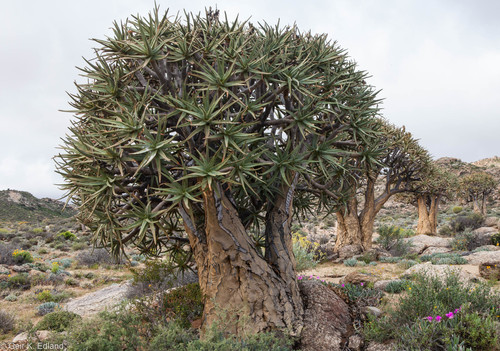
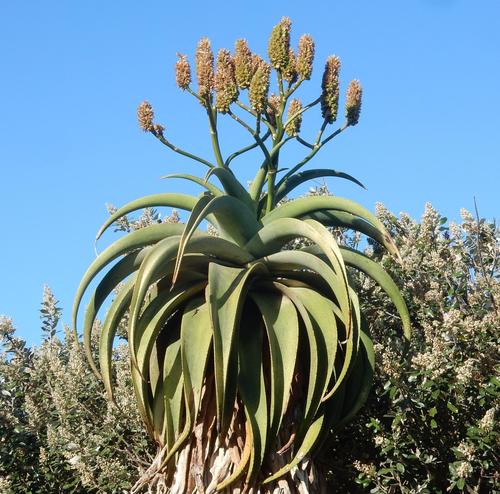
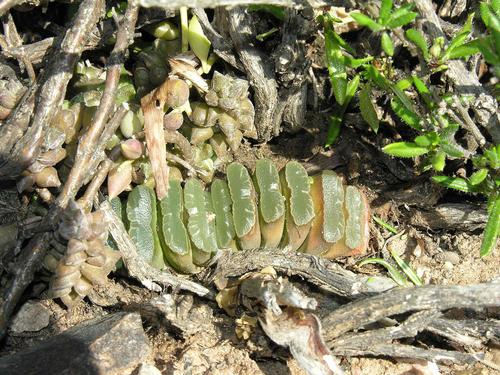
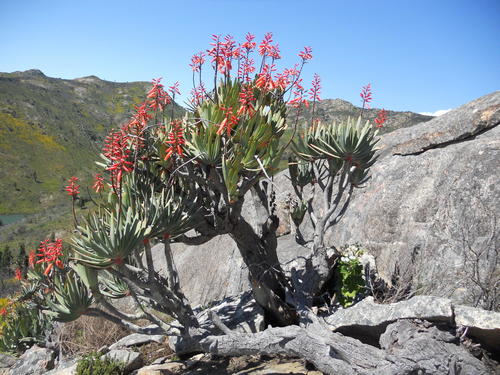
Kumara plicatilis (L.) G.D.Rowley can grow to a height of 3–5 metres (10–16 ft). Its trunk is covered in corky, fire-resistant bark, and its branches fork into pairs without a central main stem, a growth pattern called "dichotomous" branching. The branches hold clusters of succulent, oblong, tongue-shaped leaves arranged in two opposite rows to form a fan shape. To some observers, the clusters of leaves look like a collection of grey hands raised in the air. The leaves are grey-green, around 300 mm long and 40 mm wide, with tiny teeth along their edges that are only visible upon close inspection. Kumara plicatilis shares this unusual two-row (distichous) leaf arrangement with its small stemless sister species, Kumara haemanthifolia, which grows in the same small mountainous area of the Western Cape, South Africa. At the end of winter, between August and October, the plant produces large clusters of bright pink flowers that give the impression of the plant bursting into flame. In the wild, Kumara plicatilis grows only in a small area of the Western Cape, between the town of Franschhoek and Elandskloof. It grows in well-drained, sandy, slightly acidic soil on steep, rocky, south-facing slopes. It has a notably disjunct distribution, with 17 separate populations that are often more than 10 kilometres (6.2 mi) apart from one another. Its entire natural range falls within the fynbos biome, where it is the only tree aloe. The fynbos biome is made up of dense Mediterranean-type vegetation, with a climate of dry hot summers and cold wet winters. Few other members of the tribe Aloeae grow naturally in this region of South Africa; the exceptions are the Fynbos aloe, Aloiampelos commixta from Table Mountain, and Kumara plicatilis's rare sister species Kumara haemanthifolia. Protected areas that host wild populations of Kumara plicatilis include Jonkershoek Nature Reserve, Hottentots Holland Nature Reserve, Limietberg Nature Reserve and Paardenburg Nature Reserve. Kumara plicatilis is an attractive, interesting accent plant for sunny gardens, and it is increasingly used as an ornamental for drought-tolerant landscaping and rockeries. It grows very slowly, however, so outside its natural habitat it is often at risk of being overgrown, smothered and killed by faster-growing plants growing nearby. In the United Kingdom, this plant must be grown under glass because it cannot survive freezing temperatures; it may be moved out to a sunny terrace during the summer months. It has been awarded the Royal Horticultural Society's Award of Garden Merit.