About Kumara haemanthifolia (Marloth & A.Berger) Boatwr. & J.C.Manning
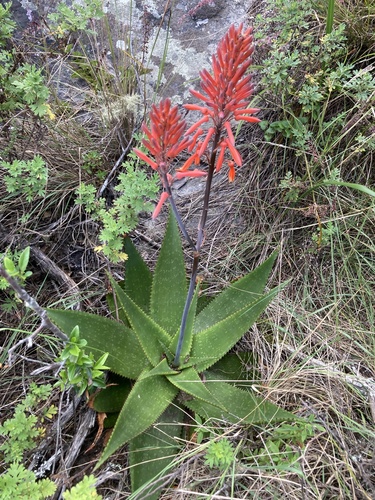
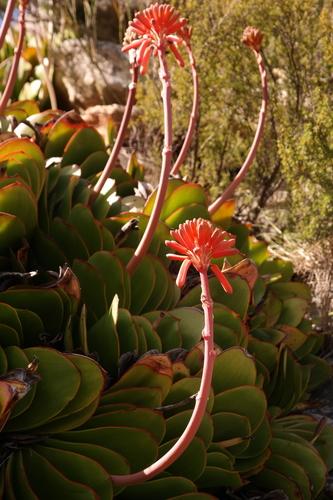
Kumara haemanthifolia is a small, clump-forming plant related to aloes. It produces greyish-green, tongue-shaped leaves that grow in a fan shape, a trait it shares with its close relative Kumara plicatilis, the fan-aloe. In overall appearance, it resembles a small, stemless version of the tree-like Kumara plicatilis. Its tightly packed oblong leaves are grey-green with bright red margins. Because it is small and grows low to the ground, it often goes unnoticed or is misidentified as a lily. Its specific epithet "haemanthifolia" refers to its visual similarity to the common genus of bulbous plants Haemanthus. It produces bright scarlet flowers at the end of winter, which falls between June and August in its native range.
Its natural distribution nearly overlaps with that of Kumara plicatilis, spanning mountainous terrain from Stellenbosch to Ceres. Unlike its larger sister species, Kumara haemanthifolia grows at higher elevations on mountain peaks. It favors cold south-facing slopes that receive heavy winter rainfall, and grows in sheltered cracks in sandstone ridges, forming dense clumps. When growing tucked into rock crevices in its native habitat, it is extremely hardy, able to survive both frost and wildfire. It has a large, strong rootstock that allows it to resprout even after all above-ground growth is completely destroyed by veld fire.
Kumara haemanthifolia is very difficult to cultivate, and typically dies quickly when planted outside of its natural habitat.