About Kuettlingeria teicholyta (Ach.) Trevis.
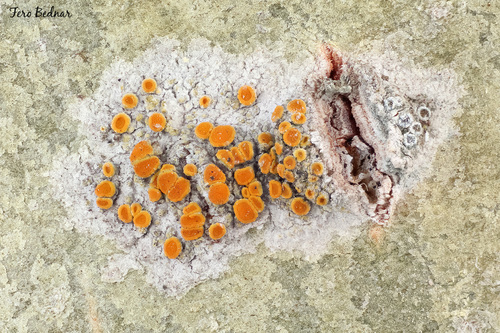
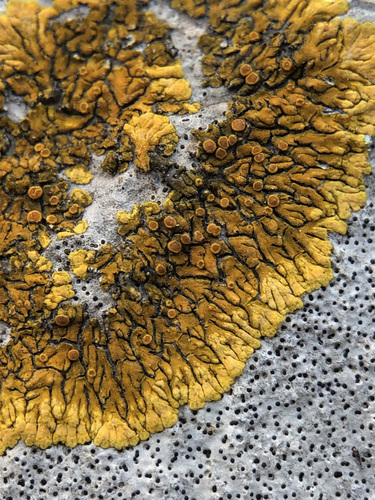
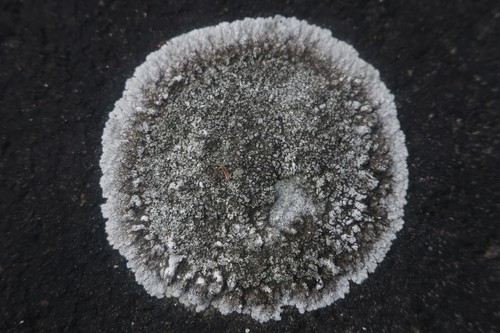
Kuettlingeria teicholyta (Ach.) Trevis. is defined by its vaguely placodioid thallus. This thallus usually forms tightly appressed, rounded structures that range from thin to thick, and are white-grey in colour. The lobe ends of this species are often poorly differentiated, appearing as rounded, flat, or slightly convex features that lack distinct furrows. These lobes form a complete ring around the edge of the thallus, giving the organism its overall rounded shape. The surface of Kuettlingeria teicholyta is uniform and scurfy, particularly towards the centre of the thallus, and small granules are commonly found on its surface. Weak areolation may occasionally appear on the thallus. The soredia of this species are granular and white, and typically form when the central surface of the thallus erodes. Apothecia, while uncommon in Kuettlingeria teicholyta, are quite noticeable when they do develop. They can grow up to 0.8 mm in diameter, and are either scattered across the thallus or sometimes crowded together. When young, these apothecia are embedded in the thallus and deeply concave, but they become flat as they mature. If a thalline margin is present, it is white and wavy, while the proper margin is wavy, swollen, and bright orange. The apothecia discs range in colour from orange to red to brown, and sometimes have a white pruinose coating. The paraphyses of Kuettlingeria teicholyta are slender, wavy, and branched, with no swelling at their tips. Ascospores are ellipsoid, with dimensions of 15–18 by 7–10 μm. The septum is usually less than 4 μm wide, and makes up no more than one-quarter of the total length of the ascospore. Chemical spot testing gives a negative result (K−) for the thallus, while apothecia give a K+ (purple-red) reaction. Kuettlingeria teicholyta belongs to chemosyndrome C5, where 7‐chloro-emodin is the dominant secondary metabolite, occurring alongside a substantial amount of fragilin. This species is found in Africa, Asia, and Europe.