About Kuehneromyces mutabilis (Schaeff.) Singer & A.H.Sm.
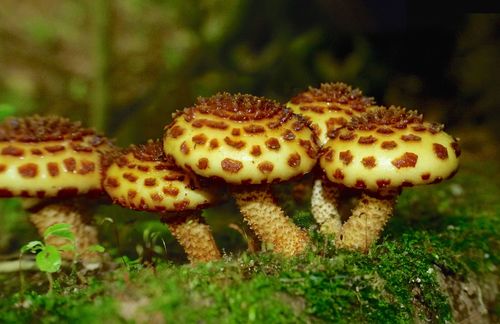
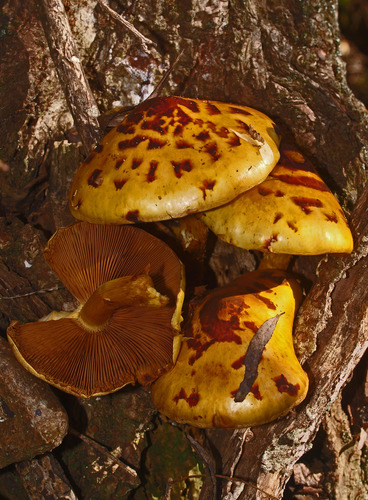
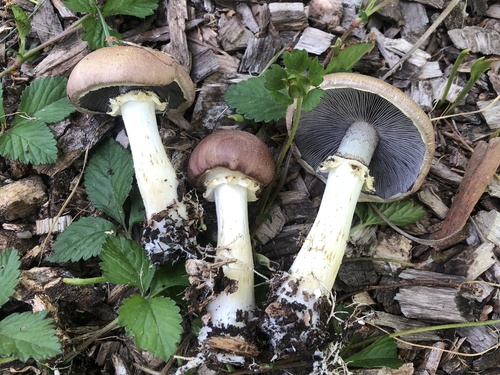
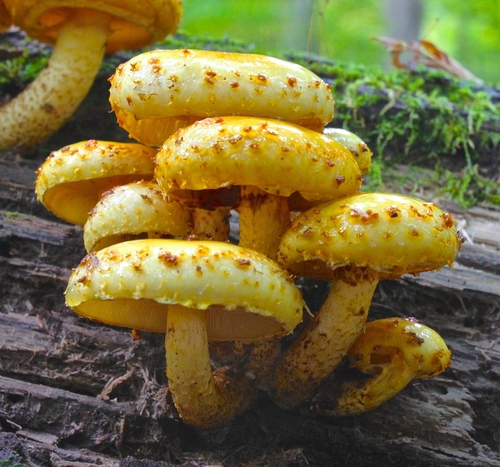
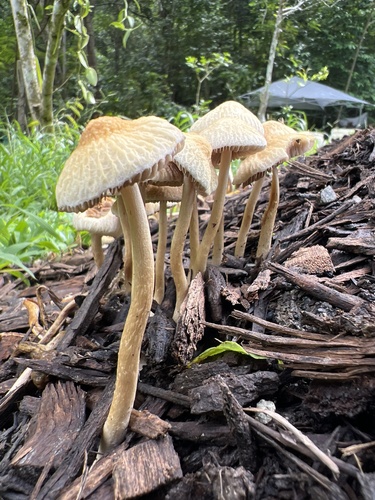
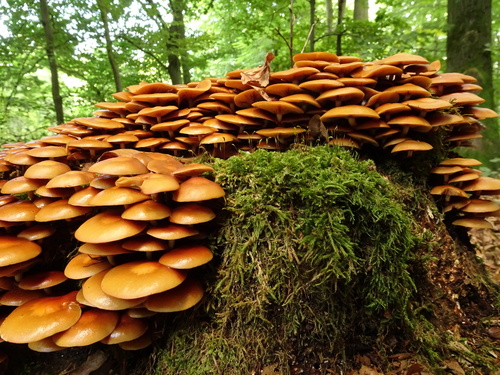
Kuehneromyces mutabilis produces clustered, shiny, convex caps that can reach up to 8 centimetres (3+1⁄4 inches) in diameter. Caps are very hygrophanous: when damp, they are shiny and greasy, with deep orange-brown colour towards the rim, and often have a disc of lighter, less sodden flesh in the centre. When dry, caps are cinnamon-coloured. The gills start light, turn brown, and are sometimes somewhat decurrent. The spore print of this species is rusty brown. The stipe measures 4–9 cm long and less than 1 cm in diameter, and has a ring that separates the bare, smooth light cinnamon upper section from the darker brown, shaggily scaly lower section. This characteristic stem structure is sometimes described as "booted". Kuehneromyces mutabilis is distributed across North America, Australia, Asia – specifically the Caucuses, Siberia, and Japan – and Europe. In Europe, its range extends from Southern Europe to Iceland and Scandinavia. This species always grows on wood, most commonly on stumps of broad-leaved trees, especially beech, birch and alder, and rarely grows on conifers. It can be found from April to late October, and also appears during the remaining winter months when conditions are mild. It is often visible at times when few other fungi are present.