About Kroenleinia grusonii (Hildm.) Lodé
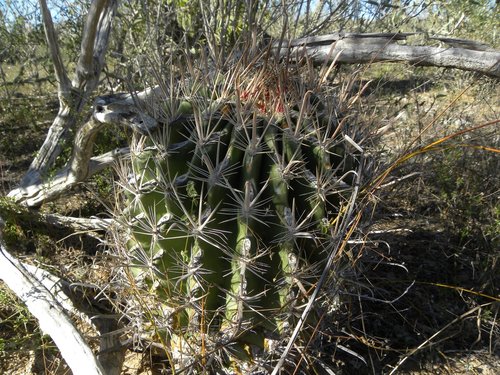
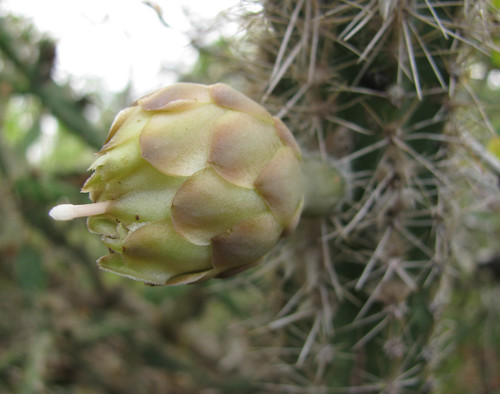
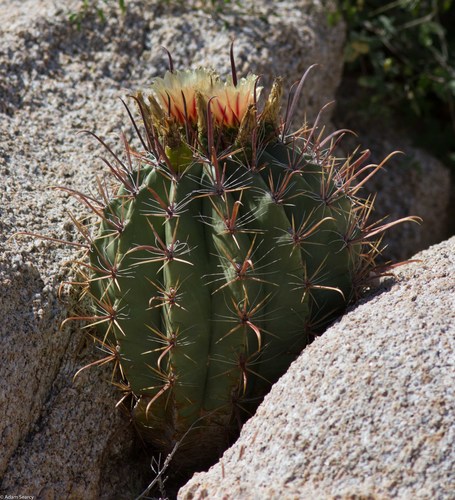
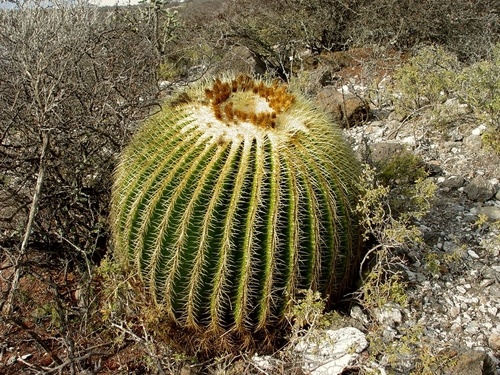
Kroenleinia grusonii (Hildm.) Lodé, commonly known as the golden barrel cactus, typically grows large with a roughly spherical shape. It is generally solitary, though adult specimens may produce basal shoots. After many years of growth, it can eventually reach over 1 metre (3.3 ft) in height, with a diameter between 40 and 80 centimeters (around 2–3 feet across). The estimated generation lifespan for this species is 10–30 years. Younger plants differ in appearance from mature specimens: they show more green tissue and have lighter-colored spines. Mature plants develop 21 to 35 pronounced ribs, which are absent in young plants that have a knobbly appearance instead. Areoles are yellow and somewhat woolly on young plants, then turn whitish, and finally become greyish as the plant ages. The sharp spines are long, straight or slightly recurved, and most often various shades of yellow; they occasionally occur in white or beige. Spines are quite large, somewhat textured (but not serrated), and spaced 1 to 2 cm (up to 1 inch) apart from each other. This species has 8 to 10 evenly arranged radial spines that measure more than 3 cm (1.2 in) in length. It has 3 to 5 central spines that measure about 5 cm (nearly 2 inches); these are strong, striated, fairly straight, though the central spines may curve slightly downwards. Puffy yellow flowers grow in summer around the top crown of the plant, and only emerge after many years on older specimens. The flowers are 4 to 6 centimeters (up to 2.5 inches) long, 3 to 5 centimeters (1.2 to 2.0 inches) in diameter, and each bloom lasts three days. The resulting fruits are spherical, somewhat elongated, edible, yellowish-green, and covered in white wool. They measure 1.2 to 2 centimeters long and contain smooth, shiny brown seeds. If left undisturbed, flowers are pollinated by nectivorous bats, bees, and lepidopterans, and the mature seed pods are dispersed by wind or animals. In its natural state, the golden barrel cactus is rare and endangered, and is potentially regionally extinct in the wild. It is native to the Mexican states of Querétaro and Hidalgo, particularly near Mesa de León. Wild populations of K. grusonii were heavily negatively impacted in the 1990s by both poaching of wild specimens and the construction of the Zimapán Dam and reservoir in Hidalgo. While it is a fairly adaptable species, it naturally prefers to grow in rich, well-aerated volcanic soil on sunny slopes, where water drains quickly away from its roots. It can grow at altitudes up to 1,400 metres (4,600 ft) above sea level. Kroenleinia grusonii is widely cultivated by specialty plant nurseries as an ornamental plant, used for container planting, desert habitat gardens, rock gardens, and conservatories. Three selected forms are in cultivation: a white-spined form, a short-spined form, and the teal-blue cultivar 'Blue barrel'. It is among the most popular cacti for private collections and landscaping, and has grown increasingly popular as an architectural accent plant in contemporary garden designs. It is considered one of the easiest cacti to care for, and grows relatively quickly in warm climates across the world. It has a few basic cultivation requirements: it needs an average minimum winter temperature of 12 °C (54 °F), though it can tolerate brief periods of lower temperatures if given adequate cover and frost protection, and good soil drainage is the most critical factor for successful growth. Like most succulents, it requires less water during winter; in its native habitat, it grows on elevated sloped slopes where precipitation and runoff quickly drain away from its roots, and standing pooled water quickly causes root rot and kills the entire plant. In some climates, it can survive brief exposure to temperatures as low as −8 °C (18 °F). Despite being endangered and locally extinct in its native range in central Mexico, K. grusonii can be found in many countries across several continents, in both non-native wild populations and private and public gardens. It is especially popular in desert plant collections at botanical gardens, where it is often successfully bred and propagated. In the United Kingdom, the golden barrel cactus has earned the Royal Horticultural Society's Award of Garden Merit. In the Americas, it occurs from Mexico south through Chile, and is notably widespread across the American Southwest and the U.S. West Coast. It also grows on several Caribbean islands. Outside of the Americas, it can be found almost everywhere around the Mediterranean Sea and the Levant, through the Middle East to South Asia, as well as in South Africa, Australia, and other locations.