About Kopsiopsis hookeri (Walp.) Govaerts
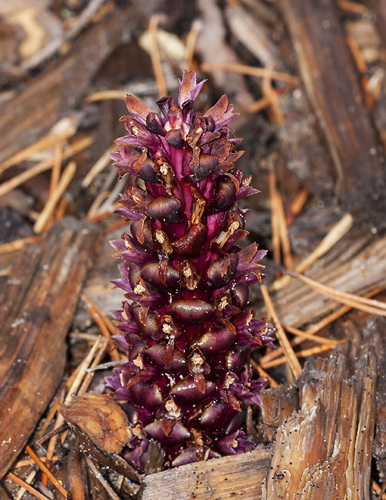
Kopsiopsis hookeri (formerly classified as Boschniakia hookeri) is a parasitic plant that parasitizes salal bushes. It penetrates salal bushes with haustoria to take up nutrients. Only the plant's inflorescence, commonly called groundcone, appears above ground. This aboveground inflorescence is cone-shaped, colored purplish, brown, or yellowish, and measures 3 to 6 cm (1.2 to 2.4 in) long. Pale flowers grow out from between the plant's overlapping bracts. Coastal aboriginal groups traditionally ate the potato-like stembase of ground cones raw, usually as a small snack rather than a main food source. Some taxonomists now place this species in the genus Kopsiopsis instead of Boschniakia, based on phylogenetic evidence. Morphological evidence suggests this species may have exchanged genetic material with Kopsiopsis strobilacea in regions where the two species have overlapping distributions. This plant is native to western North America, ranging from British Columbia south to northern California, where it grows in wooded habitats.