About Kogia sima (Owen, 1866)
Scientific Classification and Naming
The dwarf sperm whale, scientifically named Kogia sima, is a species of sperm whale that lives in temperate and tropical oceans across the globe, particularly along continental shelves and slopes.
Taxonomic History
It was first formally described by biologist Richard Owen in 1866, using illustrations created by naturalist Sir Walter Elliot. From 1878 to 1998, the species was considered the same as the pygmy sperm whale Kogia breviceps.
Size
This is a small whale species, with individuals measuring between 2 and 2.7 meters (6 feet 7 inches to 8 feet 10 inches) long and weighing 136 to 272 kilograms (300 to 600 pounds).
Physical Appearance
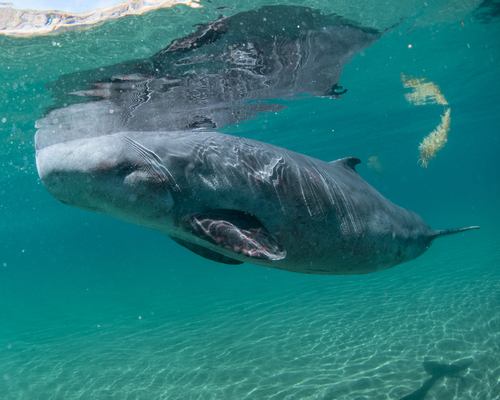
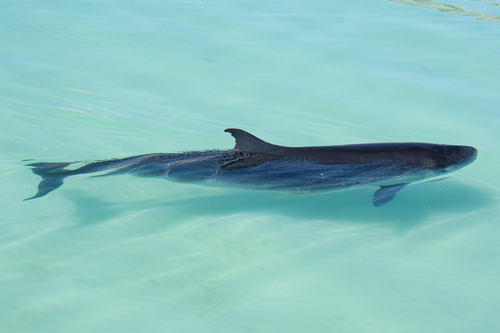
It has a grey body, square-shaped head, small jaw, and a sturdy build.
Distinction from Pygmy Sperm Whale
Its appearance is extremely similar to the pygmy sperm whale, with the main difference being the position of the dorsal fin: the dwarf sperm whale’s dorsal fin sits closer to the middle of its body, while the pygmy sperm whale’s sits closer to the tail.
Feeding and Social Structure
Dwarf sperm whales are suction feeders that primarily eat squid, and they typically travel in small pods of one to four individuals.
Predators
Their predators include orcas (Orcinus orca) and large sharks such as the great white shark (Carcharodon carcharius).
Anti-predator Behavior
When startled, dwarf sperm whales can eject a cloud of red-brown fluid.
Knowledge Source
Because sightings of the species in the open ocean are very rare, nearly all current knowledge of the dwarf sperm whale comes from individuals that have washed ashore on beaches.
Causes of Stranding Death
Many stranded dwarf sperm whales die from parasitic infestations or heart failure.
Hunting Threat
Small numbers of dwarf sperm whales are hunted across parts of Asia.
Other Human-related Threats
The greatest threats to the species are entanglement in marine debris and ingestion of marine debris.
Conservation Status
No global population estimate has been calculated, so the International Union for Conservation of Nature (IUCN) lists the dwarf sperm whale as least concern.
Global Habitat Range
The dwarf sperm whale’s range covers all the world’s tropical and temperate oceans, where it occupies continental shelf and slope areas.
Water Temperature Preference
It appears to prefer warmer waters than the pygmy sperm whale.
Stranding and Sighting Frequency
It is one of the most commonly beached deep-diving whale species worldwide, but is rarely encountered at sea, so most information about the species comes from examining beached individuals.
Diving Depth
The average diving depth of the dwarf sperm whale varies by location: a study in the Bahamas recorded an average depth of around 250 meters (820 feet), while a study in Hawaii’s deeper waters recorded an average depth of around 1,500 meters (4,900 feet).
Pacific Ocean Range
In the West Pacific, the species’ recorded range extends from Japan to Tasmania and New Zealand; in the East Pacific, it extends from British Columbia to central Chile.
Indian Ocean Range
In the Indian Ocean, the dwarf sperm whale has been reported off Oman, Sri Lanka, India, Thailand, the Philippines, Indonesia near Timor, western Australia, and South Africa.
Atlantic Ocean Range
In the West Atlantic, it has been recorded from Virginia to southern Brazil; in the East Atlantic, it ranges from Italy in the Mediterranean Sea to South Africa.
Global Population Estimate Status
No global population estimate for the species exists.
Regional Population Survey Limitations
Population counts have been done for limited regions, but because it is so difficult to distinguish dwarf sperm whales from pygmy sperm whales, these combined counts cover both species.
Regional Combined Population Estimates
In the North Atlantic, the combined estimate for both species is around 3,785 individuals, while in the East Pacific it is around 11,200 individuals.