About Koeleria macrantha (Ledeb.) Schult.
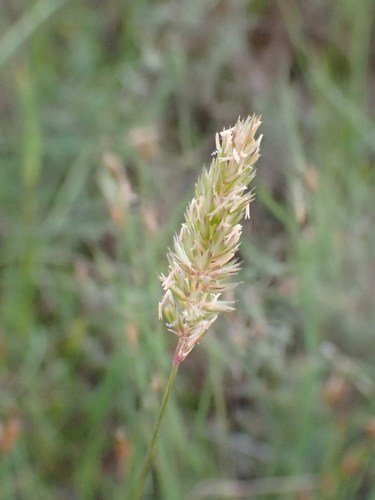
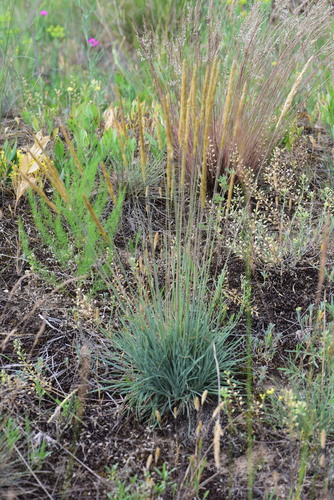
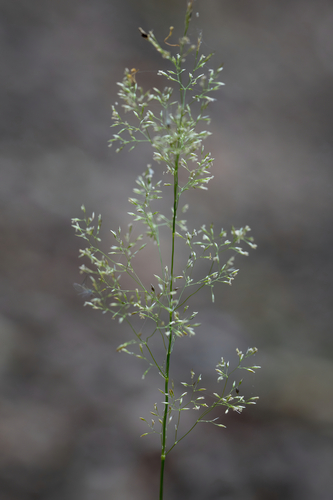
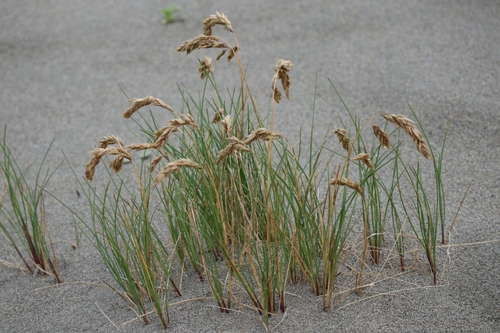
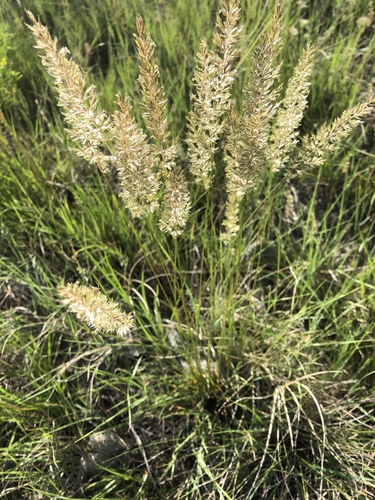
Koeleria macrantha (Ledeb.) Schult. is a short, tuft-forming perennial bunchgrass that grows 20 to 70 centimetres (8 to 27 and 1⁄2 inches) tall. Its blue-green leaves are mostly basal and grow up to around 20 centimetres (8 inches) long. The inflorescence is nearly cylindrical, and may taper slightly toward the tip. It holds shiny tan spikelets that are sometimes tinted purple; each spikelet is about half a centimetre long. Its fruit is a grain that breaks apart once it reaches full ripeness. Koeleria macrantha is widespread across most of Eurasia and North America. This grass favors cooler seasons, such as early spring or fall. It grows primarily in rocky or sandy, well-drained areas within forests or plains, and prefers full direct sunlight over partially shaded sites. It can grow at elevations ranging from 121 to 2,480 metres (397 to 8,136 feet) above sea level, and is commonly found in prairie habitats. It is classified as locally endangered in the U.S. state of Ohio. Ecologically, Koeleria macrantha is good forage for many types of grazing animals. It is a dietary staple for all classes of livestock and multiple species of prairie wildlife, depending on its current seasonal growth stage. It provides reliable nourishment for livestock in early spring, and is consumed by several species of deer, elk, and sheep because it can grow in remote areas where the environment is not suitable for other plant life. Because it grows in scattered populations, it is not a major dietary staple for most wildlife, but still provides moderate nourishment to prairie wildlife. It is palatable to all livestock and wildlife during its post-curing stage in spring and fall, but palatability drops for most species when seed production starts before curing. Koeleria macrantha spreads slowly through seed distribution. Over time, it can spread into adjacent plant communities and act as an invasive species. A number of insects feed on K. macrantha, including the striped flea beetle (Phyllotreta striolata), which feeds on its roots and foliage. Koeleria macrantha is classified as a severe allergen for humans who have grass allergies. For human uses, its seed can be ground into powder, which can then be boiled in water to make porridge, or processed into flour or bread. The plant's leaves can be woven together to make brooms or brushes. Long stalks of the plant can be strung together with other plant fiber or string, and used for cleaning pots and pans. It has also been used as a building material when mixed with adobe, for its adhesive properties and added strength.