About Knipolegus striaticeps (Orbigny & Lafresnaye, 1837)
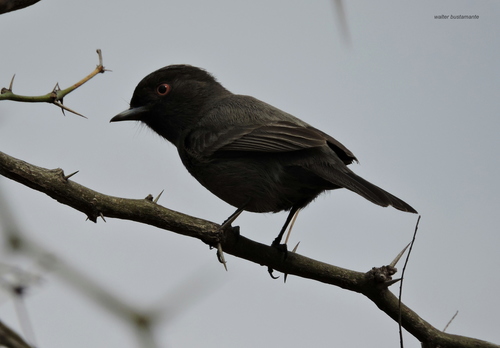
The cinereous tyrant, with the scientific name Knipolegus striaticeps (Orbigny & Lafresnaye, 1837), measures 13 to 13.5 cm (5.1 to 5.3 in) long. Adult males have plumage in various shades of gray; the term "cinereous" means ash-colored. Males have mostly dark gray upperparts. Their head is darker than the rest of their body, creating the appearance of a hood, while their face is blackish gray. Their wings are dusky gray or blackish gray, with grayish edges on the inner remiges and thin pale gray tips on the coverts that form two visible wing bars. Their tail is dusky, with pale outer webs on the outermost feathers. The throat and breast are a duskier gray than the back, and the belly is grayish white or whitish with thin dusky streaks.
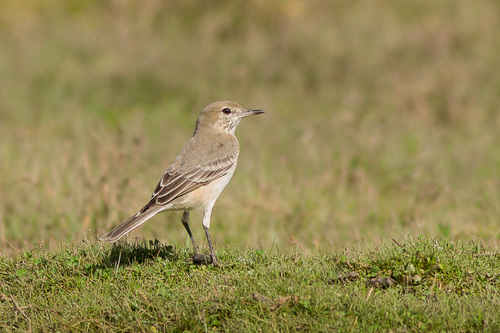
Adult females have mostly olive-brown heads and upperparts, plus a rufous crown, whitish lores, dusky streaks on the nape, and rufous uppertail coverts. Their wings are olive-brown, with white tips on the coverts that form two visible wing bars. Their tail is olive-brown, with rufous inner webs on the tail feathers. The throat and breast are buff, with thin gray streaks across the breast. The belly is whitish.
Males have a bright scarlet iris, while females have a pale brown iris. Both sexes have a black bill, and black legs and feet.
The cinereous tyrant's range extends from the Santa Cruz Department of eastern Bolivia, south through western Paraguay, into northwestern Argentina as far as the western part of Córdoba Province and the northern part of San Luis Province. It has also been recorded as a vagrant in far western Mato Grosso do Sul, in southwestern Brazil. It lives along woodland edges and in woodland openings within the Gran Chaco region. Most of its population occurs below 1,000 m (3,300 ft) in elevation, though it can be found locally up to 1,900 m (6,200 ft).