About Knipolegus poecilurus (P.L.Sclater, 1862)
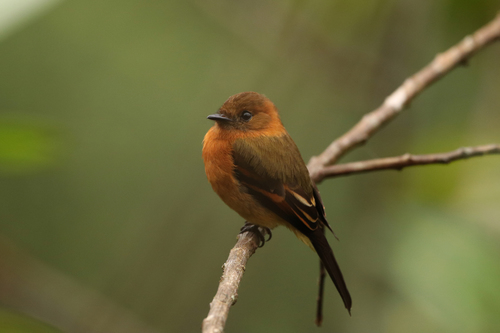
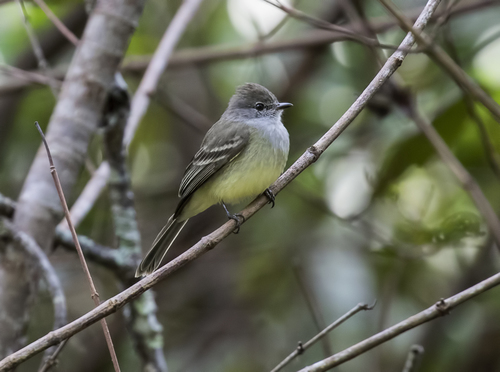
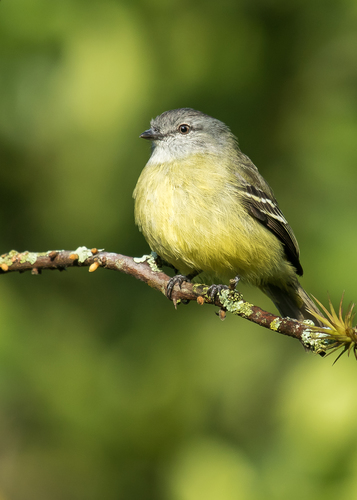
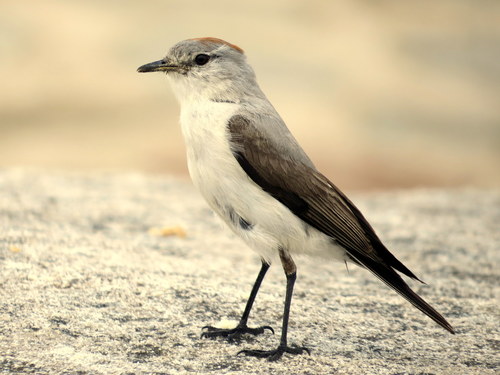
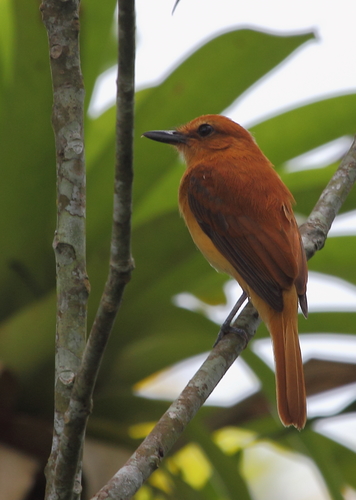
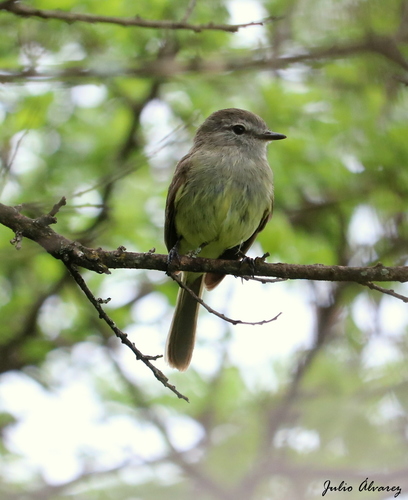
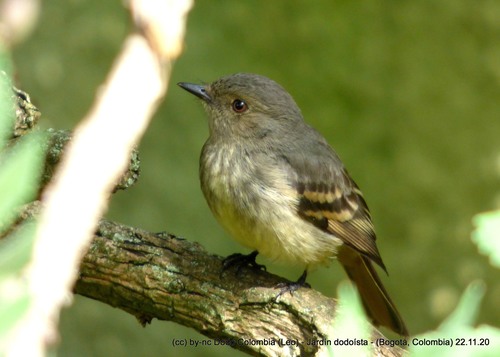
The rufous-tailed tyrant, scientifically named Knipolegus poecilurus (P.L.Sclater, 1862), measures 14.5 to 15 cm (5.7 to 5.9 in) long and weighs 13 to 15 g (0.46 to 0.53 oz). For the nominate subspecies K. p. poecilurus, adult males have mostly grayish to brownish gray heads and upperparts, plus a whitish throat. Their wings are dusky, with buff edges along the inner remiges and buffy-gray tips on the coverts that form two distinct wing bars. Their tail is dusky, with wide cinnamon edges on the inner webs that are clearly visible when the bird is in flight. Their underparts are dull buffy gray or cinnamon-buff, with a gray wash over the breast. Adult females are very similar to males, but are slightly browner across their whole body. Both sexes have a red iris, a moderately long black bill, and black legs and feet. Juveniles have a cinnamon wash to their plumage, more rufous color in the tail than adults, cinnamon wing bars, and a brown iris. Four additional recognized subspecies differ from the nominate and one another as follows: K. p. salvini has grayer upperparts than the nominate, no wing bars, very little rufous in the tail, a white belly, and a rufous vent; K. p. venezuelanus is intermediate in traits between K. p. salvini and the nominate subspecies; K. p. paraquensis is smaller and darker than the nominate, with no wing markings and no rufous in the tail; K. p. peruanus is variable in appearance, but is generally darker than the nominate. The rufous-tailed tyrant has a disjunct distribution, with each subspecies occupying a separate range: K. p. poecilurus is found in the Colombian Andes and Serranía del Perijá on the Colombia-Venezuela border; K. p. venezuelanus is found in Venezuela's western states of Táchira and Mérida, and separately in Venezuela's northern Capital District; K. p. paraquensis is restricted to Cerro Sipapo, a tepui in Venezuela's northwestern Amazonas state; K. p. salvini occurs on tepuis in southern Venezuela's southern Amazonas and southern Bolívar states, as well as in immediately adjacent western Guyana and northern Brazil; the South American Classification Committee of the American Ornithological Society also records this species from Suriname; K. p. peruanus is found along the eastern slope of the Andes, from western Sucumbíos Province in northeastern Ecuador south through Peru into western Santa Cruz Department of Bolivia. The rufous-tailed tyrant lives in a variety of mostly somewhat open landscapes. In the Andes, it inhabits edges and clearings of humid montane forest, shrubby areas adjacent to these habitats, and pastures with scattered trees. In most other parts of its range, it uses the same landscapes and also occupies secondary forest. In Peru, it can also be found in stunted ridgetop forest growing on nutrient-poor soil. In southern Venezuela, it mostly lives in stunted second growth forest on white-sand soils that have a high density of Melastomataceae plants. Its elevation range varies by location: it occurs between 1,500 and 2,500 m (4,900 and 8,200 ft) in Colombia, mostly between 1,000 and 2,000 m (3,300 and 6,600 ft) in Ecuador, between 900 and 2,300 m (3,000 and 7,500 ft) in Peru, between 500 and 2,500 m (1,600 and 8,200 ft) in Brazil, and up to 1,350 m (4,400 ft) in Venezuela.