About Knipolegus hudsoni P.L.Sclater, 1872
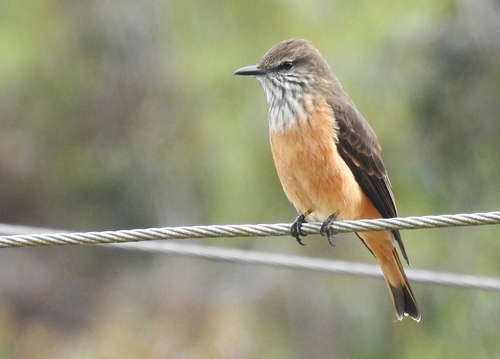
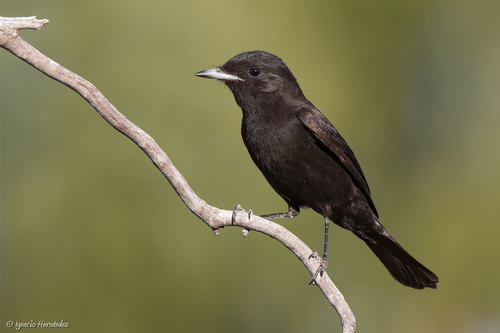
Hudson's black tyrant, scientifically named Knipolegus hudsoni P.L.Sclater, 1872, measures approximately 15 to 15.5 cm (5.9 to 6.1 inches) in length. Adult males are almost entirely shiny black. A wide white band is present on the inner webs of their primary flight feathers; this band is very visible when the bird is in flight, but it is usually hidden when the bird is perched. Adult males also have small whitish patches on their lower flanks. Adult females have mostly grayish brown coloring on the head and upperparts, with a rufous rump and rufous coloring on the basal half of the tail. The remaining portion of the tail is grayish brown, with a blackish band across its tip. Females have dusky wings, with buff-colored tips on the wing coverts that form two distinct wing bars. Their underparts are mostly buffy to ochre, with dusky-olive streaks on the breast that become lighter as they extend onto the belly. Both sexes share the same physical traits: a red iris, a blue-gray bill with a black tip, and black legs and feet. This species is distributed from northern Bolivia, south through western Paraguay, into Argentina, reaching as far south as eastern Neuquén, northern Río Negro, and southwestern Buenos Aires provinces. It has also been recorded as a vagrant in Brazil and Peru. Hudson's black tyrant inhabits somewhat open woodland and scrubland. In the northern part of its range, it can also be found in Gran Chaco woodlands, shrubby pastures, and gardens. Most populations of the species occur at elevations below 500 m (1,600 ft).