About Knipolegus cyanirostris (Vieillot, 1818)
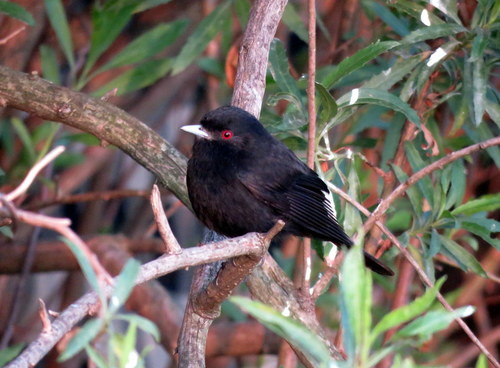
The blue-billed black tyrant, with the scientific name Knipolegus cyanirostris (Vieillot, 1818), measures 14.5 to 15 cm (5.7 to 5.9 in) in length. Adult males are almost entirely glossy black, with only faint white edges on the underside of their remiges. Adult females have mostly rufous-brown upperparts; their crown is a brighter rufous, their rump is rufous, and their tail coverts are bright cinnamon. Their wings are blackish, with buff to cinnamon edges on the coverts that form two distinct wing bars. Their tail is dusky, with rufous edges along the individual feathers. Their underparts are mostly whitish to yellowish white, covered in heavy blackish brown streaks, and their crissum is cinnamon-rufous. Males have a bright red iris, a pale blue bill with a black tip, and black legs and feet. Females have a pale red to orange iris, a blackish bill that usually has a bluish mandible, and black legs and feet. The blue-billed black tyrant is distributed from Mato Grosso do Sul, Minas Gerais, and Espírito Santo in southern Brazil, south through Uruguay and eastern Paraguay into Argentina, reaching as far south as northern Buenos Aires Province. It primarily inhabits the edges of humid forest and gallery forest, and avoids the interiors of these forests. Less frequently, it can also be found in semi-open scrublands located near forest. Its elevation range extends from sea level up to 2,200 m (7,200 ft).