About Ketupa zeylonensis (J.F.Gmelin, 1788)
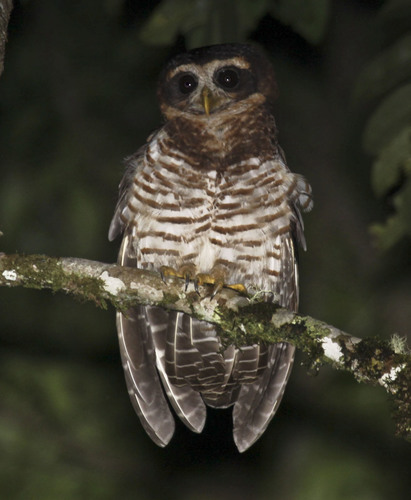
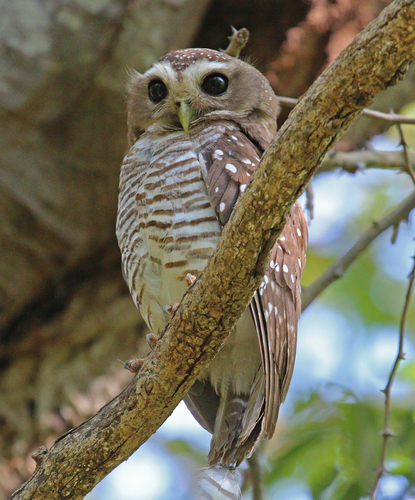
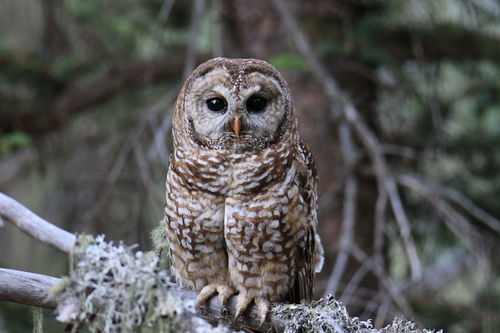
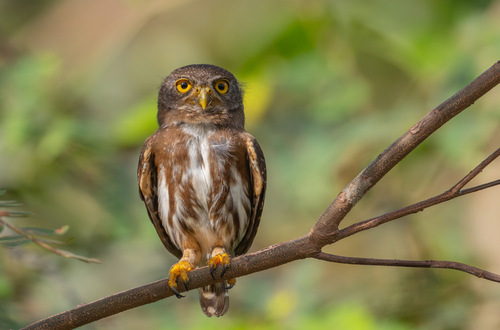
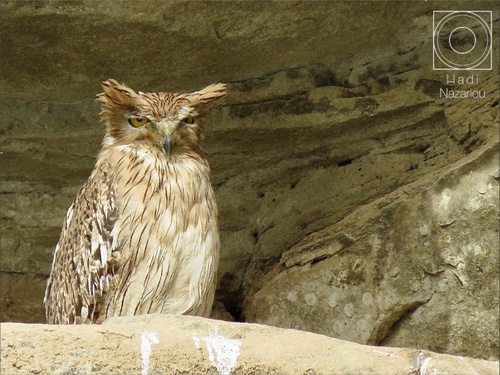
The brown fish owl (scientific name Ketupa zeylonensis, originally published by J.F.Gmelin in 1788) has prominent ear tufts and rufous brown upperparts that are heavily streaked with black or dark brown. Its underparts range from buffy-fulvous to whitish, marked with wavy dark brown streaks and finer brown barring. The throat is white and noticeably puffed, the facial disk is indistinct, the bill is dark, and the iris is golden yellow. Its featherless feet are yellow. Two-year-old brown fish owls are somewhat paler than full adults, and females and males differ slightly in size. The species measures 48 to 61 cm (19 to 24 in) in body length, with a wingspan of 125 to 140 cm (49 to 55 in). Body weight varies considerably from 1.1 to 2.5 kg (2.4 to 5.5 lb), with much of the size variability coming from differences across subspecies. Females are always at least slightly larger than males, and body condition also varies between individuals. It is slightly larger than the buffy fish owl, with a darker brown overall hue. Compared to eagle owls of similar total length, fish owls have shorter tails, heavier body builds, relatively larger wings, considerably longer legs, and a rough texture on the bottom of the toes. Both the longer legs and rough toe texture are clear adaptations to help capture fish. Diurnal raptors that feed heavily on fish have the same rough texture under their toes, which helps the birds grip slippery fish. Unlike diurnal fish-capturing raptors such as osprey, and unlike most terrestrial raptors, fish owls have large, powerful curved talons with a longitudinal sharp keel under the middle claw, and all talons have sharp cutting edges that closely resemble those of eagle owls. Also unlike diurnal fish-eating raptors, fish owls do not submerge any part of their body while hunting, preferring to only put their feet into the water, though they will hunt on foot while wading into shallow water. Unlike most owls, fish owls' feathers are not soft to the touch, and they lack the comb and hair-like fringes on the primaries that let other owls fly silently to ambush prey. Because these specialized feather traits are absent, fish owl wing beats produce sound. The brown fish owl specifically is often described as having noisy wing beats, sometimes said to produce a singing sound, though one other description claims they can be "as silent as any other owl" in flight. The lack of a deep facial disc in fish owls further indicates that sound is less important to them than vision, since facial disc depth and inner ear size are directly linked to how critical sound detection is to an owl's hunting behavior. Also different from nearly all other owl types, the bill sits on the face between the eyes rather than below them, which is said to give this fish owl a "remarkably morose and sinister expression". Similar adaptations, such as not submerging more than their legs and lacking sound-muffling feathers, are also seen in African fishing owls, which do not appear to be closely related. The brown fish owl has sometimes been considered the same species as Blakiston's fish owl, but there is a roughly 2,000 km (1,200 mi) gap between their distributions, plus many physical differences, most notably Blakiston's fish owl is considerably larger. The brown fish owl is a year-round resident across most tropical and subtropical areas from the Indian subcontinent to Southeast Asia and surrounding regions. West of its main range, it occurs patchily in the Levant (where it is possibly extinct) and southern Asia Minor (where it was rediscovered recently). Its typical habitat is forest and woodland bordering streams, lakes, or rice fields. It mainly inhabits lowlands, ranging from open woodland to dense forest, and also occurs in plantations. In the Himalayan foothills, it can be found in submontane forest up to around 1,500 m (4,900 ft) above sea level, but no higher. It often spends the daytime in stands of bamboo or other large shady trees. It can be found around water reservoirs, along canals, on the outskirts of villages, and along sea coasts. Populations in the western part of the range live in semiarid landscapes and may breed in oases within arid regions. Regardless of habitat type, it rarely strays far from large bodies of water such as rivers and lakes. As a large predatory bird, it only occurs at low population density in most areas; the exception is Sri Lanka, where the species' ability to adapt to human-altered habitats has allowed it to maintain high population numbers. The territorial pre-breeding song of the brown fish owl is a trisyllabic tu-hoo-hoo, and its call has been compared to that of a distant Eurasian bittern. The brown fish owl is primarily nocturnal, but can often be located by small birds that mob it while it roosts in trees. In some regions, it may be semi-diurnal and has been observed hunting during the daytime, especially in cloudy weather. It primarily hunts by waiting on a rock overhang or hanging perch over water, or by wading into shallow water. It captures food by gliding over the water, nearly skimming the surface with its feet, and grabbing prey by quickly extending its long legs. It feeds mainly on fish, frogs, and aquatic crustaceans, especially Potamon crabs. It usually selects the larger freshwater fish available in waterways. Unlike the tawny fish owl which prefers flowing water, brown fish owls often hunt in still or stagnant water. By individual count in India's Melghat Tiger Reserve, freshwater crabs from the family Gecarcinucidae (genus Barytelphusa) made up almost the entire diet. Brown fish owls may be drawn to ornamental fish ponds or commercial fisheries to feed on the easily caught fish at these sites. Amniotes, especially terrestrial amniotes, are rarely eaten. Other recorded prey items include snakes, lizards, water beetles, other insects, small mammals (including bats), and occasionally water birds. In Melghat, the largest biomass of prey consisted of small mammals, specifically rats of the genus Rattus, other murids, and Asian house shrews (Suncus murinus). Water birds hunted by brown fish owls have included the lesser whistling duck (Dendrocygna javanica) and Indian pond heron (Ardeola grayii). One unusual recorded prey item was an 11 in (28 cm) long monitor lizard. This species may compete with Pallas's fish eagles (Haliaeetus leucoryphus) and dusky eagle owls (Ketupa coromandus), but the brown fish owl is more terrestrial than Pallas's fish eagle, and consumes more invertebrates than either of those species. Pallas's fish eagle feeds mainly on fish followed by water birds, while the dusky eagle owl feeds mainly on mammals followed by land birds. If hungry, brown fish owls will scavenge carrion, a rare behavior for owls. One observation recorded a brown fish owl feeding on a putrefying crocodile (Crocodylus spp.) carcass. The prehistoric Ketupa insularis is sometimes included within the brown fish owl. If this classification is correct, its different foot anatomy (more similar to a typical eagle owl) would suggest this population shifted back to feeding on terrestrial prey. A likely prey item for this population would have been the Sardinian pika (Prolagus sardus). It has been hypothesized that these owls went extinct alongside their prey due to climate change, though the giant pikas of Sardinia and Corsica still existed around 1750, and eventually died out soon after from habitat destruction, introduced predatory mammals, and overhunting. Brown fish owls breed from November to April, with breeding activity peaking slightly earlier in the northern part of their breeding range and slightly later in the more tropical southern part. The breeding season aligns with the dry season, which has the advantage of low water levels, making crabs and fish more easily accessible. Most other owls and diurnal raptors also primarily breed during the dry season. Since owls do not build their own nests, brown fish owls are opportunistic when selecting nesting sites. They often nest in shady spots such as old-growth mango trees (Mangifera spp.), fig trees including Ficus religiosa and Ficus benghalensis, Shorea robusta, and other large trees in lowland forests. Besides the bare surface of large branches, nests are often located in sites such as overgrown eroded ravines and steep riverbanks with natural holes. They may also nest near suitable villages, along wet roadsides, jheels, canals, and rice fields. Nests are usually large natural holes, hollows, or spots at the base of large branches. Abandoned nests built by fish eagles and vultures are also sometimes used as nesting sites. Other documented nesting sites include rock ledges, caves on shady cliff faces, and stone ruins. The clutch size is two eggs, or occasionally just one. The average size of 10 eggs collected in India was 58.4 mm × 48.9 mm (2.30 in × 1.93 in), with eggs from more northern populations averaging slightly larger. Incubation lasts 38 days or somewhat less, and young owls fledge after about seven weeks. Downy chicks are mostly off-white, and develop into a paler version of adult plumage by their second year.