About Ketupa sumatrana (Raffles, 1822)
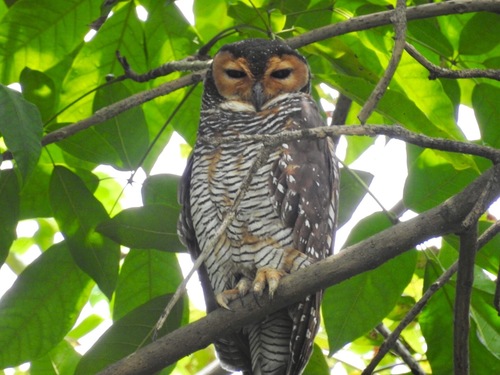
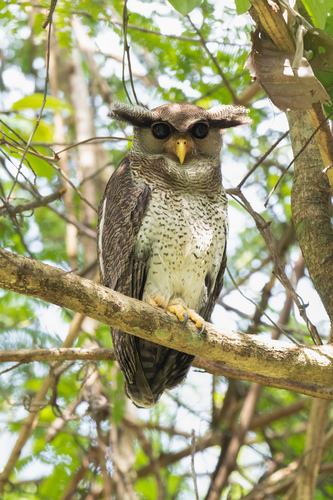
The barred eagle-owl, scientifically named Ketupa sumatrana, is a fairly large owl that is relatively small among eagle-owls, with a total body length ranging from 40 to 48 cm (16 to 19 in). Unusually for eagle-owls, this species shows almost no size sexual dimorphism (only some females are slightly larger than males), and adjacent island subspecies vary dramatically in size. Its most distinctive features include barred underparts, large sideways-slanting ear tufts, a white bar running from the eyebrows through the front of the ear-tufts, and much heavier marking on the breast than the belly. The face and lores are dirty grayish-white. Eyes are most often dark brown, though occasional yellow-eyed individuals have been reported. The bill and cere are pale yellow, and the cere sometimes has a faint greenish tinge. The upperparts are grey-brown, crossed and mottled with multiple zigzag rufous-tawny bars that are broadest on the back. The upper tail is dark brown with around six whitish or tawny bars. The tarsi are feathered down to the toe joint. Juvenile barred eagle-owls have pure white natal down. In the mesoptile transition stage to adult plumage, juveniles remain dirty white overall, have brown banding on the wings and tail, and have much shorter ear tufts than mature birds. The brown wood owl (Strix leptogrammica) is a potential species that could be confused with the barred eagle-owl, though this confusion is unlikely. Like the barred eagle-owl, the brown wood owl is barred on the underparts, but as a member of the Strix genus, it lacks the barred eagle-owl's distinctive ear tufts. It is also much more rufous-brown, has a strongly defined brownish-cinnamon facial disc, and has more extensive foot feathering that almost completely covers the feet except for the talons. Fish owls have unfeathered tarsi, a more tawny overall body color, and lack the white stripe on the head and ear-tufts. The dusky eagle-owl (Ketupa coromanda) occurs in the northern part of the barred eagle-owl's range. It has a sandy warm brown color, vertical barring on the underside, minimal contrasting whitish barring on the plumage and face, and yellow eyes. The spot-bellied eagle owl, which forms a superspecies with the barred eagle-owl, is far more superficially similar to the barred eagle-owl than the other species mentioned above, but the two do not appear to overlap in range in the wild. The spot-bellied eagle owl is much larger and has bolder spotting on the underparts, but is otherwise almost identical to the barred eagle-owl. The barred eagle-owl is found in Brunei, Indonesia, Malaysia, Myanmar, Singapore, and Thailand. Its natural habitat is subtropical or tropical moist lowland forests. It typically resides in evergreen forests near pools or streams, but also occurs in large gardens with tall, densely leaved trees (such as Bogor Botanical Gardens in West Java) and wooded groves in cultivated areas, both of which are often located not far from human settlements. It usually occurs at elevations from sea level up to around 1,000 m (3,300 ft), but can be found up to around 1,600 m (5,200 ft) or higher at sites including Mount Gede in West Java and Mount Singgalang in West Sumatra. What little is known about the barred eagle-owl's diet shows it has a very broad, opportunistic diet. Like other eagle-owls, the barred eagle-owl has large, powerful feet for its size, with large, heavy, slightly curved talons. This indicates it can take a diverse range of prey, and can catch relatively large prey when the opportunity arises. Recorded prey items include large insects such as grasshoppers and beetles, birds, small mammals (especially rodents like various mice and rats), and reptiles, mostly snakes. In one recorded case, a barred eagle-owl preyed on a young crab-eating macaque (Macaca fascicularis), which even as a juvenile is around the same size or larger than the owl. When kept in captivity, this species is not picky and will eat fresh meat from fish, birds, and mammals. In one case, a barred eagle-owl kept in an aviary with a changeable hawk-eagle (Nisaetus cirrhatus) killed and ate the hawk-eagle, despite the two being similar in body size. This shows the species' ferocity and lack of discrimination when it comes to prey, which is also similar to other eagle-owls.