About Ketupa nipalensis (Hodgson, 1836)
The spot-bellied eagle-owl, scientifically named Ketupa nipalensis (Hodgson, 1836), is a large owl species. Adults measure 50 to 65 cm (20 to 26 in) in total length. On average, it ranks as the sixth longest owl species in the world, and has the ninth longest wings among all living owls. The commonly cited body weight range for this species is 1.3 to 1.5 kg (2.9 to 3.3 lb), but this is likely on the lower end—this range may come from the subspecies K. n. blighi, or may only represent the weights of smaller males. This body mass range is similar to that of the larger race of barred eagle-owl, which is considerably smaller than spot-bellied eagle-owl in total length, standard measurements, and overall appearance. One female, shot near Haputale in Sri Lanka’s Badulla District where spot-bellied eagle-owls are smaller than their northern counterparts, weighed 1.7 kg (3.7 lb). A more accurate average weight range for the full species is likely 1.5 to 2.5 kg (3.3 to 5.5 lb). A large owl presumed to be this species, recorded in the illegal Indian wildlife trade, reportedly weighed 3 kg (6.6 lb).
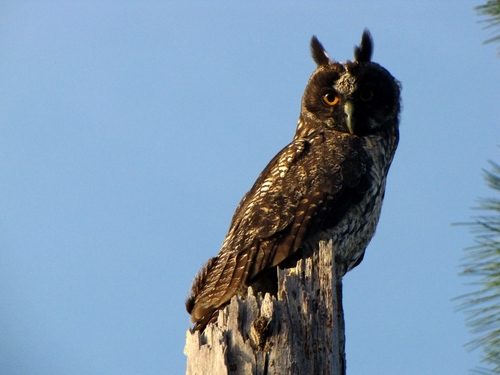
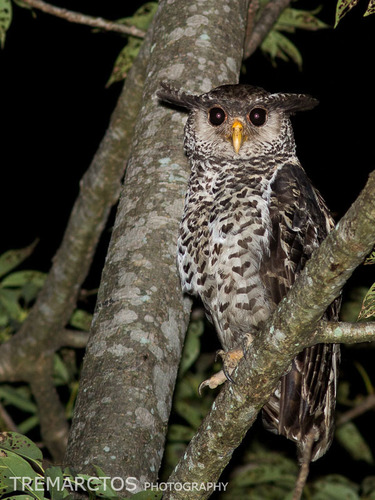
This species has very long ear-tufts with noticeably variable lengths, which gives their tips a somewhat scraggly appearance. Ear-tufts of the spot-bellied eagle-owl measure 63 to 76 mm (2.5 to 3.0 in) in length. Like most eagle-owls, the spot-bellied eagle-owl has feathered legs and feet, but the terminal toe digits are bare before the talons. Its feet and talons are as formidable as any eagle-owl’s: they are very large, heavy, and powerful for the species’ overall size. Typical standard measurements for the species are: 425 to 477 mm (16.7 to 18.8 in) in wing chord length, 230 to 250 mm (9.1 to 9.8 in) in tail length, 60 to 62 mm (2.4 to 2.4 in) in tarsal length, and 52 to 54 mm (2.0 to 2.1 in) in culmen length.
The Sri Lankan subspecies K. n. blighi is linearly around 10% smaller than spot-bellied eagle-owls from further north in India, but matches the size of owls from the southern tip of India. Standard measurements for K. n. blighi are: 370 to 455 mm (14.6 to 17.9 in) in wing chord length, 184 to 240 mm (7.2 to 9.4 in) in tail length, 63 to 68 mm (2.5 to 2.7 in) in tarsal length (longer than that of northern birds), and 43 to 48 mm (1.7 to 1.9 in) in culmen length. One individual from Sri Lanka was recorded with a 44.2 mm (1.7 in) middle talon, a 50.6 mm (2.0 in) toe length, and a 143 cm (56 in) wingspan. This recorded talon length is very large relative to the size of the owl; even relatively small Eurasian eagle-owls of the subspecies Bubo bubo hispanus from Spain had smaller talons than this Sri Lankan spot-bellied eagle-owl. Other than size, the only difference distinguishing northern birds from Sri Lankan birds is an ill-defined band of honey-brown colour on the pectorals of the Sri Lankan subspecies.
Overall, the spot-bellied eagle-owl is a distinctly grayish-brown bird, with dark coarse brown colouration on its back and upper wings. Its throat and underparts are mainly pale fulvous, with black and white horizontal stripes along the body flanks that widen into broad spots on the abdomen and undertail coverts. On the wings, the primaries are dark brown with lighter brown stripes, while the secondaries are more heavily barred with buff-brown colouration. The lores are covered in bristly feathers, and the cheeks are brownish-white with black feather shafts. The species’ large ear-tufts slant out to the sides. Juvenile spot-bellied eagle-owls are distinct from adults, being much paler grayish-cream overall with fairly heavy brownish barring.
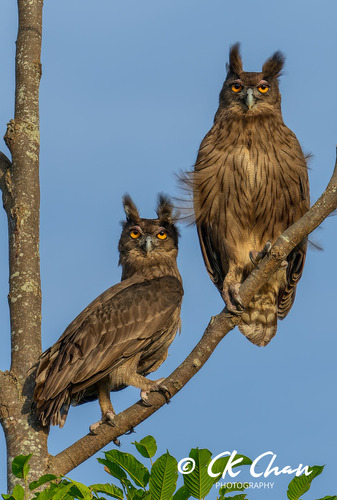
Distinguishing the spot-bellied eagle-owl is relatively straightforward, because other eagle-owl species in India and Southeast Asia do not typically live in deep forests as this species does. Within its range, the spot-bellied eagle-owl is the second largest owl, only outsized by the tawny fish owl (Ketupa flavipes), which is restricted to mountain stream habitats and feeds exclusively on aquatic prey. The brown fish owl (Ketupa zeylonensis), which has quite different colouring when clearly observed, is slightly smaller linearly than the spot-bellied eagle-owl and occupies more wetland-based, often more degraded, habitats. The Himalayan subspecies of Eurasian eagle-owl (Bubo bubo hemachalana) may inhabit higher elevations of the same mountains where spot-bellied eagle-owls occupy lower-elevation forested foothills, and their ranges barely overlap. Indian eagle-owls (Bubo bengalensis), which typically live in wooded areas around rocky terrain, are around 10% smaller than spot-bellied eagle-owls. Dusky eagle-owls (Ketupa coromanda), which typically live in woodlands near wetlands, are around 15% smaller. The brown wood owl, the largest Strix species widely found in the Indian subcontinent and Southeast Asia, is around 35% smaller. Furthermore, the colouring and markings of the spot-bellied eagle-owl are distinct from all species except the barred eagle-owl, which does not share a wild range with the spot-bellied eagle-owl.
Both the barred and spot-bellied eagle-owls can be immediately told apart from other eagle-owls in their ranges by their pale-looking, sideways-slanting ear-tufts, and the extent of feathering on their legs and feet. Unlike other co-occurring eagle-owls, this species pair has horizontal rather than vertical underside markings over a much paler base colour. In the barred eagle-owl these markings coalesce into barring, while on the spot-bellied eagle-owl they appear as almost continuous spotting. Additionally, the back of the spot-bellied eagle-owl is slightly grayer, and lacks warmer brown or tawny tones found on other eagle-owls.
The spot-bellied eagle-owl is distributed across the Lower Himalayas from Kumaon east to Burma, and continues into central Laos and central Vietnam. It occurs across the entire Indian subcontinent and peninsular Southeast Asia, reaching its southern range limits in Sri Lanka and as far south as 12 degrees north in southern Thailand. This species mainly lives in primary or older second growth forests. While it can potentially occupy nearly all types of terrestrial habitat, it prefers dense evergreen forests or moist deciduous forests within its range. It does extend into tropical valleys, terai, and shola habitats in the lower hills of India. Though often described as uncommon to somewhat rare, recent photographic evidence shows that the species is widespread across different parts of India, and likely simply avoids detection as long as suitable wooded habitat remains. It occurs in a range of climates from the temperate woodlands of Nepal to the humid tropical rainforests of Southeast Asia. The spot-bellied eagle-owl is mainly a species of tropical and subtropical foothills, and is mostly found at elevations between 900 and 1,200 m (3,000 to 3,900 ft), but can occur from sea level up to 6,300 m (20,700 ft) in the Transhimalayas.