About Ketupa ketupu (Horsfield, 1821)
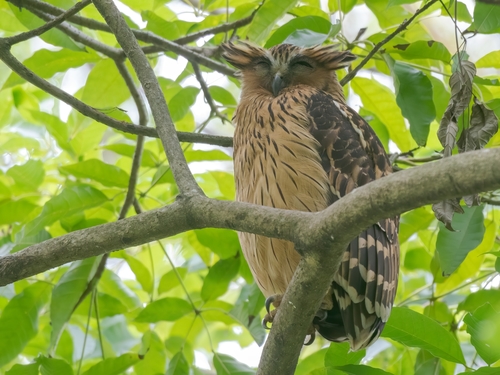
The buffy fish owl, with the scientific name Ketupa ketupu (Horsfield, 1821), has a buff brown base plumage, with darker tawny brown feathers on its back. Its face is paler than the body, and it has light brown eyebrows. Adults measure 40 to 48 cm (16 to 19 in) in length and weigh 1,028 to 2,100 g (36.3 to 74.1 oz), making it the smallest fish owl species. Like all fish owls, the buffy fish owl has prominent ear tufts on the sides of its head. Its wing feathers and tail have broad yellowish and dark brown bars, and its wings have a distinctly rounded shape. The underparts are yellowish brown, rich buff, or fulvous, marked with broad blackish shaft stripes. Its long legs are not covered in feathers. Fish owls have large, powerful curved talons, with a sharp longitudinal keel on the underside of the middle claw; all talons have sharp cutting edges, similar to those of eagle owls. Unlike diurnal fish-eating raptors, buffy fish owls do not submerge any part of their body while hunting—they only put their feet into the water, though they will wade into shallow water. Unlike most other owls, fish owl feathers are not soft to the touch, and lack the comb-like structure and hair-like fringes on the primary feathers that let other owls fly silently to ambush prey. Without these specialized feather adaptations, fish owl wing beats produce audible sound. Fish owls also lack a deep facial disc, which indicates that sound is less important to their hunting than vision, since facial disc depth (along with inner ear size) is directly linked to how much an owl relies on sound when hunting. Another difference from most other owl types is that the buffy fish owl’s bill sits on its face between the eyes, rather than below them; this feature is said to give the species a “remarkably morose and sinister expression”. Adaptations such as not submerging more than their legs and lacking sound-muffling feathers are also seen in the unrelated African fishing owls. Because tawny fish owls and buffy fish owls neatly replace each other across their ranges, they were once considered the same species, but multiple physical, anatomical, habitat, and behavioral differences separate the two. The buffy fish owl is distributed from Bangladesh, Myanmar, Thailand, Malaysia, and Singapore to Cambodia, Laos, Vietnam, and the Sunda Islands, and it is nonbreeding on Cocos (Keeling) Island. It lives in tropical forests and freshwater wetlands near rivers, lakes, and aquaculture sites, up to an elevation of 1,600 m (5,200 ft), and can also be found in plantations as well as rural and urban gardens. The buffy fish owl produces a range of recorded vocalizations, including hissing sounds and a rattling kutook call repeated rapidly around seven times. It also makes a loud ringing pof-pof-pof call, and a high, hawk-like hie-e-e-e-e-keek series of notes. This species is quite noisy before breeding, and mated pairs may engage in duetting bouts that last several minutes at a time. During the daytime, it usually shelters alone in trees with dense foliage. Buffy fish owl eggs have mostly been found between February and April in western Java, and less commonly into May; on the Malay Peninsula, eggs have also been recorded from September to January. The buffy fish owl often nests on top of a large fern, Asplenium nidus, but nesting has also been recorded in the fork of a tall bough covered in ferns and moss, on orchid beds, and in tree holes. More rarely, rocky sites are used for nesting, including sites behind waterfalls. Since owls do not build nests, the nest is usually just a scrape made in the surface of a fern with no additional structure or lining. This species will also use abandoned nests built by other bird species, including nests of the brahminy kite (Haliastur indus). Only one egg per breeding season has ever been recorded in buffy fish owl nests, meaning this species shares the smallest clutch size of any owl with the spot-bellied eagle owl (B. nipalensis) and the barred eagle owl (B. sumatranus), which have also only ever been recorded with single-egg clutches. The egg is round-oval and dull white. The average dimensions of eggs from western Java are 57.4 mm × 47 mm (2.26 in × 1.85 in). Egg incubation lasts 28 to 29 days, and chicks fledge after six weeks. As a large raptorial bird, this species is generally faring well, and it has been accidentally helped by commercial fisheries and ornamental ponds, which it visits at night to hunt. It is sometimes persecuted by pond owners for taking fish stock.