About Ketupa flavipes (Hodgson, 1836)
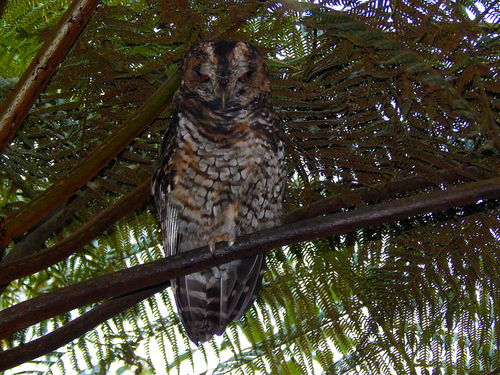
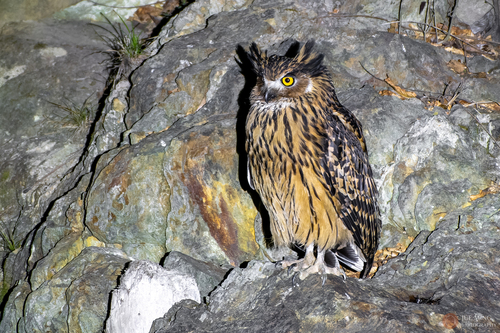
Like other fish owls, the tawny fish owl (Ketupa flavipes) has large ear tufts, which usually hang down the sides of the head and have a distinctly messy, tousled appearance. This species has yellow eyes, and has been described as the most attractive of the fish owls. Its crown and upperparts are typically orangey-rufous, overlaid with broad blackish markings on the central part of each feather, alongside matching blackish spots on the reddish-brown feather edges. The scapulars are a dingy yellow, forming a contrasting band that runs across the owl's shoulders. The flight and tail feathers have strong alternating bars of dark brown and buffish. The facial disc is poorly defined, but a noticeable off-white area on the eyebrows and forehead stands out. While buffy and brown fish owls have featherless legs and Blakiston's fish owl (Ketupa blakistoni) has fully feathered legs, the tawny fish owl has feathering covering two-thirds of its tarsi. Below the feathered section, the legs are greenish-yellow, with greyish-horn colored talons. Aside from the difference in leg feathering, the buffy fish owl is most similar in plumage but is smaller, with a buff hue rather than the tawny's orange-rufous. The brown fish owl is a much more solid brown, with distinct vermiculations on its underparts and no yellowish band across its back. Compared to eagle owls of similar body length, fish owls generally have shorter tails, heavier bodies, relatively larger wings (with tawny and Blakiston's fish owls being especially chunky in build), considerably longer legs, and a rough texture on the bottom of their toes. At least the last two of these traits are clear adaptations to help the owls capture fish. Diurnal raptors that feed mostly on fish have the same rough texture under their toes, which helps the birds grip slippery fish. Unlike diurnal fish-catching raptors such as the osprey (Pandion haliaetus), and in contrast to most terrestrial raptors, fish owls have large, powerful, curved talons and a sharp longitudinal keel under the middle claw; all talons have sharp cutting edges that closely resemble those of eagle owls. Also unlike many fish-eating diurnal raptors, fish owls do not submerge any part of their body while hunting, and only put their feet into the water. That said, fish owls do hunt on foot by wading into shallow water. Unlike most owls, fish owl feathers are not soft to the touch, and they lack the comb and hair-like fringes on the primaries that let other owls fly silently to ambush prey. Because these specialized feather features are absent, fish owl wing beats produce audible sounds. The lack of a deep facial disc in fish owls further indicates that sound is less important to these owls than vision, since facial disc depth and inner ear size are directly linked to how important sound is to an owl's hunting behavior. Similar adaptations, including not submerging more than their legs and a lack of sound-muffling feathers, are also seen in African fishing owls, which do not appear to be closely related. Tawny fish owls share roughly the same linear body dimensions as brown fish owls. They measure 48 to 61 cm (19 to 24 in) from bill to tail. However, studies show the tawny fish owl is surprisingly heavier on average than the brown fish owl, and, as expected, it is considerably heavier than an eagle owl of comparable length. Six adult tawny fish owls were found to have an average weight of 2,415 g (5.324 lb), with a recorded weight range of 2,050 to 2,650 g (4.52 to 5.84 lb), making this species one of the heaviest living owl species. Only Blakiston's fish owl and most subspecies of Eurasian eagle owl (B. bubo) have a higher average weight. The maximum (not average) weight of Verreaux's eagle owls (Ketupa lactea) and snowy owls (B. scandiacus) is also higher, though these two species have much larger sample sizes of recorded body mass. In standard measurements, the wing chord is 410 to 477 mm (16.1 to 18.8 in), the tail is 215 to 227 mm (8.5 to 8.9 in), the tarsus is 60 to 67 mm (2.4 to 2.6 in), and the bill is 48 to 52 mm (1.9 to 2.0 in). Compared to the brown fish owl, the tawny fish owl has a similar average tail length, larger average wing and bill sizes, and slightly smaller tarsal length. The tawny fish owl inhabits subtropical to temperate forests in southern Nepal, northern India, Bangladesh, Bhutan, China, Laos, Myanmar, Taiwan, and Vietnam. It lives in the Himalayan foothills from Kashmir and Garhwal east to the mountains of Laos, Vietnam, and southern China, reaching as far northeast as Zhejiang and Anhui. This species requires forested areas with mountain streams. In areas including Darjeeling and Nepal, it occurs at elevations from 1,500 to 2,450 m (4,920 to 8,040 ft). Its range partially overlaps with that of the brown fish owl (K. zeylonensis) in Laos and Vietnam, where the tawny fish owl prefers fast-flowing waters in remote wilderness with little to no human disturbance. The tawny fish owl's territorial call is a deep whoo-hoo, and it also produces a cat-like meow. Four tawny fish owls fitted with radio transmitters were monitored in Taiwan from October 1994 to July 1996. They were mainly nocturnal, leaving their daytime roosts around sunset and returning before sunrise. They were most active moving and foraging during twilight, and could move up to 1,800 m (5,900 ft) in an hour. They moved more frequently during the cold season. In summer, breeding tawny fish owls engaged in some daytime activity, mostly consisting of preening. They also hunted during the day to feed their fledglings. Each individual owl used up to 17 different roosting sites, all located in old-growth forest 20 to 550 m (66 to 1,804 ft) away from a stream. In the cold season, they roosted closer to streams, while moving to uphill roosting sites in warmer months. They avoided disturbed habitats such as grassland, agricultural land, and areas near villages. The tawny fish owl is at least partially diurnal, with daytime activity mainly occurring in the late afternoon; it may be seen actively hunting before nightfall, especially on cloudy days. Before the late afternoon, however, it tends to be sluggish during the day. If disturbed or threatened, these owls usually stay still and do not fly away. Like most owls, they typically choose inconspicuous perches during the day to avoid detection. The tawny fish owl has been described as the most powerful and savage of the three smaller fish owl species. Pellets produced by tawny fish owls in Taiwan were found on rocks, under perches and daytime roosts. The pellets contained remains of Taiwan mitten crab (Eriocheir formosa), tip-nosed frog (Odorrana swinhoana), brown tree frog (Buergeria robusta), Asiatic toad (Bufo gargarizans), freshwater crabs, shrimps, and fish. The owls preyed on toads considerably more often than other frog species, despite toads being far less numerous in streams and wetlands, because of toads' larger size. The tawny fish owl usually hunts by swooping down to the water and capturing fish from the surface; its hunting style is reported to be surprisingly active, and its hunting methods are not unlike those used by diurnal fish-hunting raptors such as fish eagles, sea eagles, and ospreys. However, the species does not avoid more terrestrial prey, and may also hunt toads, lizards, snakes, and small mammals such as moles, especially rodents. One of the few mammalian prey recorded semi-regularly is bamboo rats (Rhizomys). A small Malayan porcupine (Hystrix brachyura) has also been recorded as prey. It also preys on birds, including Mandarin ducks (Aix galericulata) in Taiwan, and has overtaken large ground birds such as junglefowl (Gallus ssp.), pheasants, and eared pheasants; the latter sometimes weigh more than 2 kg (4.4 lb). Tawny fish owls are generally sparsely distributed, and often live in riparian zones of 5.5–7.7 km (3.4–4.8 mi) in length. Like most owls, tawny fish owls are highly solitary and territorial. The breeding season is November to February in India, and December to February in Assam. Recorded nest locations include large holes in river banks, cliff caves, and the fork or crotch of a large tree. As with all owls, tawny fish owls do not build a nest, and simply lay their eggs on the bare ground of whatever surface they use. They also not infrequently nest in abandoned nests built by Pallas's fish eagles (Haliaeetus leucoryphus). Usually a clutch contains two eggs, though sometimes only one egg is laid. The eggs range in size from 56 to 58.8 mm (2.20 to 2.31 in) by 45.5 to 48.3 mm (1.79 to 1.90 in), with an average size of 57.1 mm × 46.9 mm (2.25 in × 1.85 in), and are similar in size to the eggs of the brown fish owl. More detailed information on the reproductive biology of this species is not currently available, though it is presumed to be basically similar to that of other fish owls.