About Ketupa coromanda (Latham, 1790)
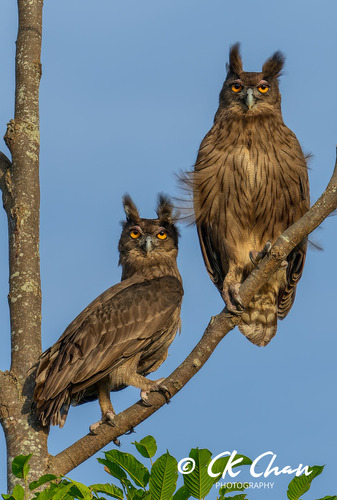
The dusky eagle-owl, scientifically named Ketupa coromanda (Latham, 1790), is a large greyish-brown owl with prominent ear tufts. Its underparts are greyish white with dark brown streaks, and its dark brown wings bear whitish streaks. The subspecies K. c. klossii resembles the nominate subspecies but is much darker, with no obvious whitish markings on its wings and scapulars. Wing length of the species ranges from 380 to 435 mm, and tail length ranges from 187 to 224 mm.
The dusky eagle-owl's distribution extends from Pakistan, India, Nepal, and Bangladesh, through Myanmar, Thailand, and Malaysia, into China. Surveys conducted in Peninsular Malaysia between autumn 2009 and 2010 recorded the species in oil palm plantations in the states of Selangor, Perak, Pahang, and Negeri Sembilan. It lives in forests, wooded wetlands, agricultural areas with scattered groves and trees, and roadside avenues with old, large trees.
Though the dusky eagle-owl is not deterred by daylight, it is mostly active at night, and leaves its roost shortly before sunset. Individuals have been observed hunting during the day in cloudy weather. Its nesting season runs from November to April, with most breeding activity recorded in December and January. Dusky eagle-owls reuse stick nests originally built by other large birds, on tree species including Ficus, Mitragyna, and Dalbergia. In Haryana, breeding pairs of the owl preferentially reused nests built by woolly-necked storks (Ciconia episcopus). Very few pairs used nests from other bird species, including red-naped ibis (Pseudibis papillosa) and Indian spotted eagle (Clanga hastata).
Woolly-necked storks in the region prefer to build nests in native Dalbergia sissoo and Ficus religiosa trees, as well as the non-native Eucalyptus trees. The owls show an additional layer of preference when reusing existing stork nests, and most often choose nests located on Eucalyptus sp. Most dusky eagle-owls reused stork nests in areas with high densities of stork nests, which suggests the owls track the breeding progress of woolly-necked storks. The Haryana study highlights the importance of multifunctional agriculture, specifically agroforestry interspersed among cereal crops, for maintaining healthy breeding populations of the dusky eagle-owls. The dusky eagle-owl is one of the least studied owl species in the world, and most existing information about its biology comes from anecdotal observations.