About Kaupifalco monogrammicus (Temminck, 1824)
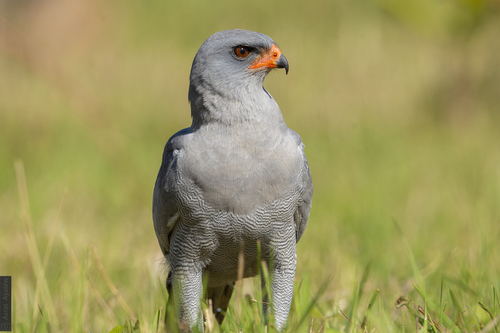
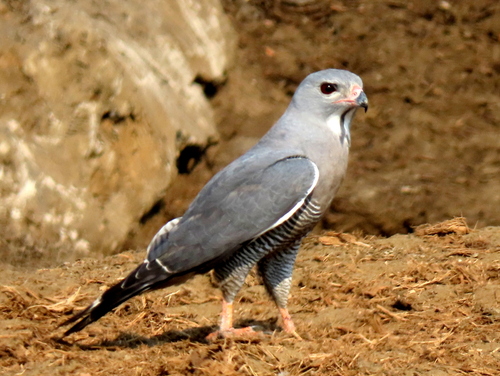
Description: The lizard buzzard (Kaupifalco monogrammicus) is a small, stocky raptor. It has a total body length of 35–37 cm and a wingspan of approximately 79 cm. On average, males weigh 245 g and females weigh 304 g. Its upperparts, head, and breast are grey. A distinctive vertical black stripe runs across its white throat, a marking that sets this species apart from all other raptors. Its belly is white with fine dark barring, its underwings are white with dark tips, and its tail is black with a white tip and a single white band. Its eyes range from dark reddish brown to black, while its cere and legs are red to orange-red. The sexes have similar plumage and markings. Its flight pattern is undulating, similar to that of a thrush. Juvenile lizard buzzards closely resemble adults, with only minor differences: juveniles have a slight brown tinge on the wings, and their cere and legs are orange-yellow. Distribution and habitat: This species is found across Sub-Saharan Africa, ranging from Eritrea to northeastern South Africa. It remains common in West Africa, Zimbabwe, Mozambique, and the northeastern regions of Namibia, Botswana, and South Africa. Its preferred habitat is moist, dense savannah woodland, especially miombo woodland, along with forest edges and wooded river margins. In winter, it can also be found in arid thornbush within the savannahs of East and Central Africa. Ecology: Lizard buzzards are solitary, generally silent raptors. They only vocalize early in the breeding season, which falls in September and October, producing a clear, distinct, melodious klu-klu-klu whistle. They are locally resident and dominant over any intruders in their range. They soar very rarely, only doing so during courtship displays or on uncommon non-breeding occasions in late morning. Lizard buzzards hunt from perches 6–10 m high, catching prey by swooping or gliding down onto targets in the grass. They have a low attack rate, and passively search for prey; this strategy uses little energy but requires more time. They rarely catch prey while in flight. They have shorter pointed wings, with a wing length to body height ratio of 0.76. This wing shape allows for faster flight within forests, and is considered an adaptation for capturing prey in dense vegetation. Their diet includes invertebrates, reptiles, and mammals. By individual count, grasshoppers and termites are their most common prey, while by biomass rodents are their most frequent prey. The reptiles they favor are lizards (especially Mabuya and Agama lizards), frogs, and snakes.