About Karpatiosorbus latifolia (Lam.) Sennikov & Kurtto
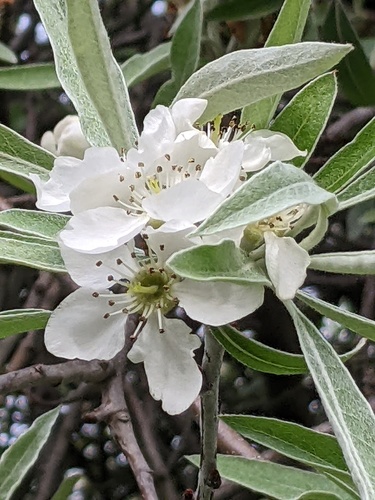
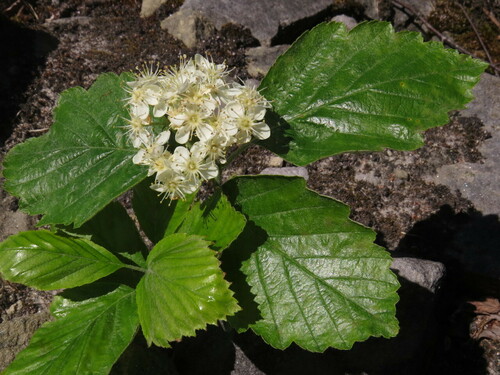
Karpatiosorbus latifolia (Lam.) Sennikov & Kurtto is a medium-sized deciduous tree that grows 10 to 20 metres tall, with a trunk up to 60 centimetres in diameter. Its leaves measure 5 to 10 centimetres in both length and width, rarely reaching up to 20 centimetres long and 12 centimetres broad; most leaves are approximately as broad as they are long, matching the meaning of its species epithet latifolia, which is Latin for 'broad-leaved'. The upper surface of the leaves is green, while the lower surface is downy with greyish-white hairs, and each leaf margin bears six to ten small triangular teeth. Its flowers are 1 to 1.5 centimetres in diameter, with five creamy-white petals and yellowish stamens. Flowers are borne in corymbs around 8 centimetres in diameter that open in mid-spring. The fruit is a globular, dull brownish-red pome 10 to 12 millimetres in diameter, dotted with large pale lenticels, and it ripens in late autumn. This species, also called the service tree of Fontainebleau, has been planted occasionally as an ornamental, in woodland plantings for arboretums, and in gardens and parks across Europe and North America ever since it was introduced to European horticulture around 1750. Because it is highly fertile and grows true from seed, it has occasionally naturalized in woodlands outside its native range in the protected Fontainebleau woods; a well-documented non-native location is Abney Park Cemetery, an early Victorian garden cemetery in Stoke Newington, London. Though it is a rare tree, it has several recorded commercial uses. Its edible fruit was sold in open-air markets at Fontainebleau until the 1950s, and its homogeneous, long-lasting wood is valuable for specific applications. The ancient woodlands where the species naturally occurs are protected by France's Office National des Forêts.