About Kalmia latifolia L.
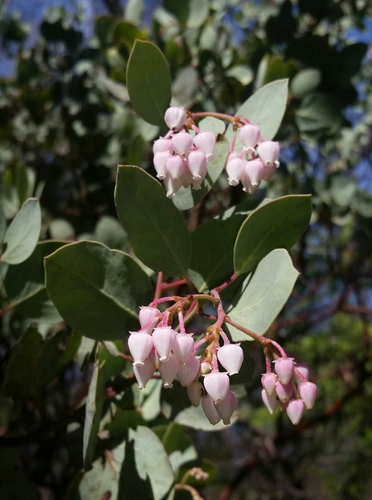
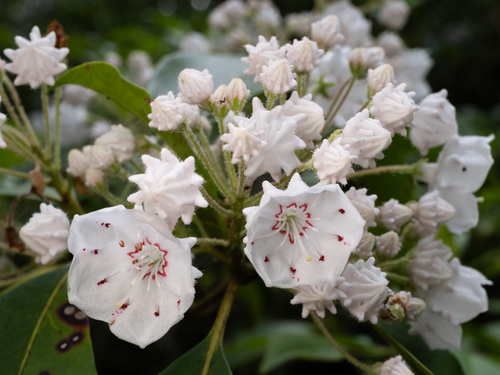
Kalmia latifolia L. is an evergreen shrub that grows 3–9 m (9.8–29.5 ft) tall. Its leaves measure 3–12 cm long and 1–4 cm wide; they are elliptic, alternate, leathery, glossy, dark green on the upper surface, yellow green on the underside, and resemble rhododendron leaves. The plant has fibrous, matted roots. Its flowers are pentagonal, range in color from light pink to white, and grow in clusters. It blooms in May and June, and there are several named cultivars with darker flower shades of pink, red, and maroon. All parts of this plant are poisonous if ingested. In its natural range, it occurs on rocky slopes and mountainous forest areas. It grows best in acidic soil, preferring a soil pH between 4.5 and 5.5. It often forms large thickets that cover large expanses of forest floor. In the Appalachians, it can grow into a tree, while it remains a shrub in areas farther north. It is a common component of oak-heath forests. In low, wet areas it grows densely, while it takes on a sparser growth form in dry uplands. In the southern Appalachians, dense Kalmia latifolia thickets are called "laurel hells" or "laurel slicks" because they are nearly impossible to pass through. Kalmia latifolia is classified as a pollinator plant that supports and attracts butterflies and hummingbirds. It is known for its unusual pollen dispersal mechanism: as the flower develops, the filaments of its stamens bend and are held under tension. When an insect lands on the flower, tension is released, and pollen is forcefully catapulted onto the insect. Experiments have confirmed the flower can fling pollen distances up to 15 cm. After retiring from the National Bureau of Standards in the 1950s, physicist Lyman J. Briggs became fascinated with this mechanism and carried out a series of experiments to explain it. Kalmia latifolia, also called mountain laurel or spoonwood, is poisonous to many animals including horses, goats, cattle, deer, monkeys, and humans, due to the presence of grayanotoxin and arbutin. All green parts of the plant, along with flowers, twigs, and pollen, are toxic. Even food products made from the plant, such as toxic honey, can cause neurotoxic and gastrointestinal symptoms in humans who eat more than a small amount. Toxicity symptoms appear approximately 6 hours after ingestion, and include irregular or difficult breathing, anorexia, repeated swallowing, profuse salivation, watery eyes and nose, cardiac distress, incoordination, depression, vomiting, frequent defecation, weakness, convulsions, paralysis, coma, and eventually death. Necropsies of animals that died from spoonwood poisoning reveal gastrointestinal hemorrhage. Kalmia latifolia was first brought to Europe as an ornamental plant in the 18th century, and it remains widely cultivated today for its attractive flowers and year-round evergreen foliage. Numerous cultivars with varied flower colors have been selected. Many cultivars were developed at the Connecticut Experiment Station in Hamden through the plant breeding work of Dr. Richard Jaynes, who created many named varieties and is considered the world's leading authority on Kalmia latifolia. In the United Kingdom, four cultivars have earned the Royal Horticultural Society's Award of Garden Merit: 'Freckles' with pale pink, heavily spotted flowers; 'Little Linda', a dwarf cultivar that grows to 1 m (3.3 ft); 'Olympic Fire' with red buds that open to pale pink flowers; and 'Pink Charm'. The Cherokee people use this plant in multiple ways. They use it as an analgesic, applying an infusion of leaves to scratches made over the site of pain. They also rub the bristly edges of 10 to 12 leaves over the skin to treat rheumatism, crush leaves to rub onto brier scratches, use an infusion as a wash to get rid of pests, use a compound preparation as a liniment, rub leaf ooze into the scratched skin of ball players to prevent cramps, and use a leaf salve for healing. They also use the wood for carving.