About Kalmia angustifolia L.
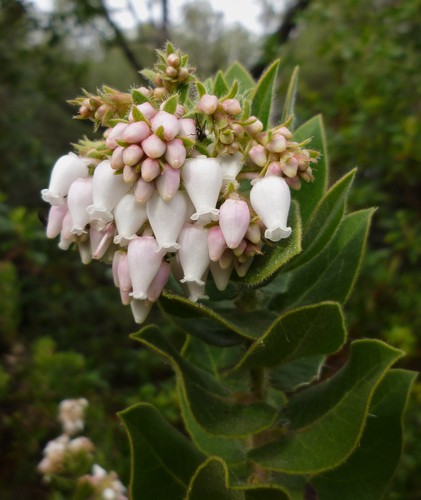
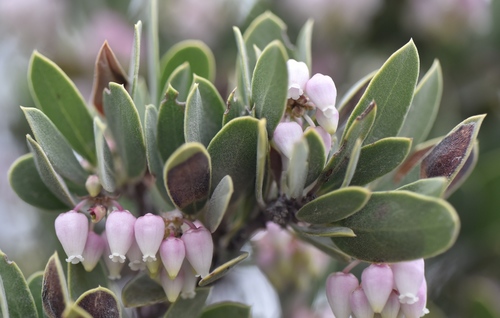
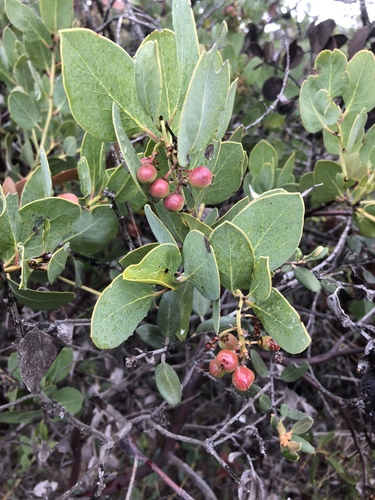
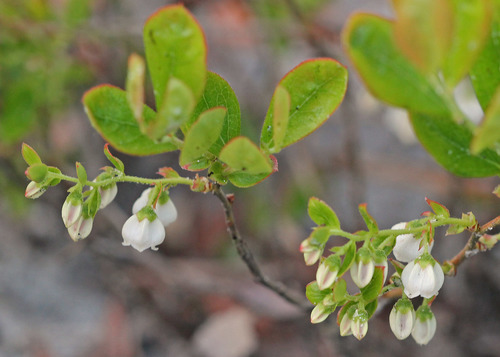
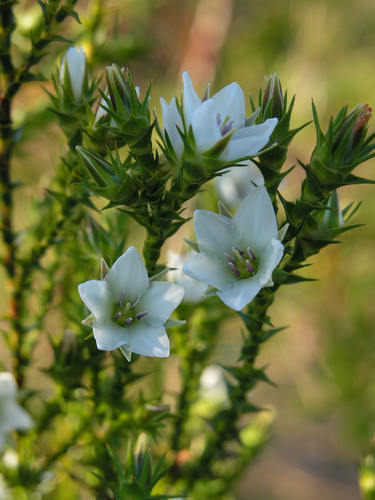
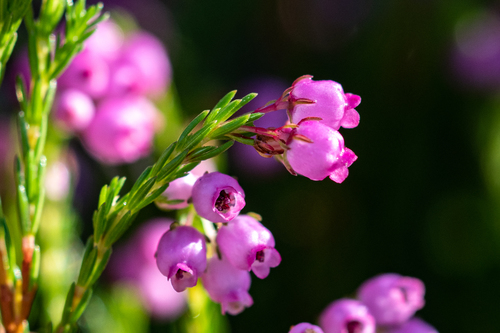
Kalmia angustifolia L. produces attractive, small, deep crimson-pink flowers in early summer. Each flower has five sepals, a corolla of five fused petals, and ten stamens fused to the corolla. Bumblebees and solitary bees pollinate these flowers. Each mature capsule holds approximately 180 seeds. In the wild, this plant varies in height between 15–90 cm (6–35 in). New shoots grow from dormant buds on buried rhizomes, and this growth process is stimulated by fire. Its narrow evergreen leaves are pale on the underside, and tend to emerge from the stem in groups of three. The Latin specific epithet angustifolia translates to "narrow-leaved". A distinctive trait of this plant is that leaf clusters usually terminate the woody stem, because flowers grow in whorls or clusters below the stem apex. Its main flowering period runs from April through May, and it produces less frequent additional blooms in the fall. Fruiting occurs in early autumn. Its phenology can be earlier if fire occurs earlier in the year. This species is distributed across eastern North America, ranging from Ontario and Quebec south to Virginia. The southern subspecies K. angustifolia ssp. carolina grows as far south as Georgia. It grows commonly in dry habitats within the boreal forest, and is also found in drier areas of peat bogs or pocosins. It can become dominant over large areas after fire or logging. Kalmia angustifolia is a common understory shrub in boreal forests of eastern North America, and often grows in black spruce forest. One study found that under closed canopies, it mostly reproduces vegetatively and produces few flowers, while it flowers significantly more in sites where black spruce was harvested and burned. Clearcut harvesting of these ecosystems has led to K. angustifolia dominating cleared sites. It is considered opportunistic, resprouting after logging and fire, and often inhibits efforts to restore conifer forests. Kalmia contains the glycoside andromedotoxin, and is poisonous to mammals. For this reason, it is considered undesirable in pastures. Several of its common names reflect its toxicity: 'lamb-kill', 'sheep kill', 'calf-kill', 'pig laurel', 'sheep-laurel' and 'sheep-poison'. It is also commonly called narrow-leaved laurel and dwarf laurel. Kalmia angustifolia is cultivated as an ornamental garden shrub. It prefers moist, acidic soil in partial shade. The species has received the Royal Horticultural Society's Award of Garden Merit. Numerous cultivars have been selected for garden use; among these, K. angustifolia f. rubra, which has rich red flowers, has also won the award. Indigenous groups used K. angustifolia to treat swelling and other inflammatory conditions. More recent research has identified potential cosmetic uses for this plant due to its chemical composition.