About Kallima sylvia (Cramer, 1776)
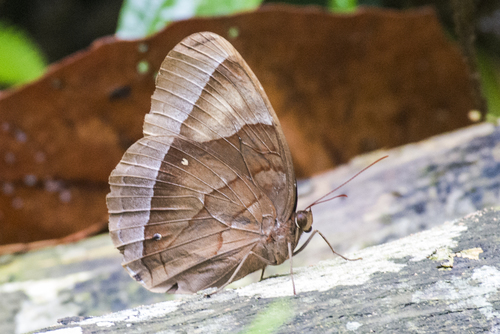
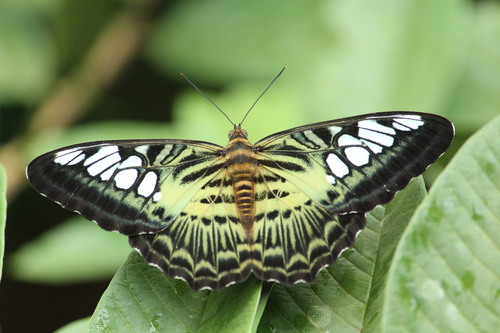
This description covers the male of Kallima sylvia (Cramer, 1776). Males have large, broad wings. The forewing is triangular: the costa is very slightly curved, the apex is rounded, the exterior margin is oblique and slightly scalloped, the posterior margin is short, and the posterior angle is convex. The costal vein extends to two-thirds of the costal margin, and is free from the subcostal in both sexes. The first and second subcostal branches are somewhat undulated; the first subcostal branch is emitted before one-half the length of the cell, the second at one-sixth before the end of the cell, and the third at half length beyond the cell, curving upward, running close along the second branch for some distance and ending at the apex; the fourth and fifth branches sit on a short footstalk that starts from near the base of the third branch. The cell is long and narrow. The upper discocellular is extremely short, bent immediately below the subcostal; the middle discocellular is inwardly oblique and straight; the lower discocellular is concave and directed inward; radials extend from the upper and lower angles. The upper median veinlet bends convexly upward beyond the cell, then extends parallel to and at an equal distance from the lower branches; the middle branch is emitted before the end of the cell, and the lower branch at a considerable distance before the end of the cell. The submedian is recurved near its base. The hindwing is short, very broad, and somewhat quadrate; the exterior margin is scalloped, and produced outward below the middle. The costal vein is much arched from the base and extends to the apex. The precostal vein is distinct, extends parallel with and joins the costal vein — forming a closed precostal cell — and gives off a short bifid spur towards the costa immediately before its junction with the costal vein. The cell is very short. The first and second subcostal branches are emitted at about equal distances from the upper base of the cell. The upper and lower discocellulars are outwardly-oblique, each slightly concave; the lower discocellular is slender, and a radial extends from their middle. Two upper median branches are emitted from the end of the cell; the upper branch bends convexly near its base, and the lower branch from one-third before the end of the cell. The submedian is curved near the base; the internal vein is straight and short. The body is stout, the abdomen is short; the palpi ascend, and are pilose beneath and above at the tip of the second joint; the second joint is very long, extending level with the vertex, and the third joint is very short and pointed. The legs are slender and long; the antennae are long, and gradually thickened towards the tip. The eyes are naked. The sexes are alike in appearance. The various forms or subspecies of Kallima sylvia are closely aligned and greatly resemble one another. The species' range includes the Western Ghats, Bangladesh, Assam, Cambodia, Myanmar, Laos, Sri Lanka, and parts of Southeast Asia: Malaya, the Philippines, and New Guinea.