About Kallima paralekta Horsfield, 1829
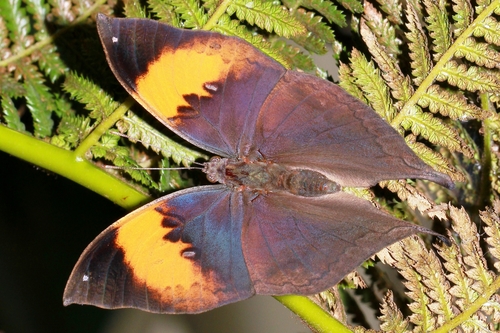
Kallima paralekta, first described by Horsfield in 1829, shows strong sexual dimorphism in the coloration of its upper wing surfaces. The upper wings of males are noted for their striking beauty: males have oblique bright orange fascia across their forewings, with the inner border of each orange band ending at the lower corner of the forewing. The area below each orange band, plus the entire upper surface of the hindwing, is a brilliant deep blue that shifts to purple. Females do not have the males' bright coloration; their upper wings are generally rusty brown, and the oblique broad band on each forewing is white instead of orange. The forewing tips of females are hooked. For both sexes, the undersides of the wings are highly variable, with no two specimens having identical patterns. The underside colors always match those of dead leaves, including shades of gray, brown, red, olive green, and pale yellow. The undersides mimic the features of decaying leaves with extraordinary realism. Blotches, dark spots, and powdery dots that look like mildew or other fungal growth are so convincing that observers often mistake the markings for actual fungal infection on the butterfly. Small, oval, scaleless hyaline spots act like transparent windows, mimicking holes chewed in leaves by insect larvae. The forewing tips are pointed, while the hindwing tips extend into a short narrow tail that resembles a leaf petiole. A line runs through the center of both the forewings and hindwings, with one side dark and the other light, to mimic the shaded and sunlit sides of a leaf midrib. Fainter lines radiate forward from this central line, mimicking the secondary venation of a leaf. This effect is created partially by wing markings and partially by incorporating the butterfly's actual wing venation. When the wings are closed, the head and antennae fit perfectly into the curve of the upper wings, so they do not disrupt the dead leaf outline. The small irregularities this creates even resemble the wrinkled edges of a withered leaf. Kallima paralekta is endemic to Indonesia. The nominate subspecies Kallima paralekta paralekta occurs only on Java, Indonesia, while the subspecies Kallima paralekta tribonia is found on Sumatra, Indonesia. The larvae of Kallima paralekta feed on plant species from the genera Strobilanthes and Pseuderanthemum. Adult butterflies rarely feed on flower nectar, and are most often observed feeding on rotten fruit. Adult males typically stay on the same perch while waiting for mates, leaving for a short flight before returning to the same spot. Kallima paralekta rose to fame in the 19th century thanks to British naturalist Alfred Russel Wallace. In his influential work The Malay Archipelago, Wallace called this species "the most wonderful and undoubted case of protective resemblance in a butterfly". He described his difficulty catching specimens in Sumatra: when in flight, the bright, vivid coloration of the butterfly's large upper wings makes it very easy to spot. But as soon as it lands, which it almost always does among dead leaves, its exceptional camouflage makes it nearly invisible. Even when observers stare directly at the spot where the butterfly vanished, they usually cannot spot it until it takes flight again a few moments later. Wallace used this butterfly as an example of natural selection, to support the evolutionary theory he developed alongside Charles Darwin.