About Kallima inachus Boisduval, 1836
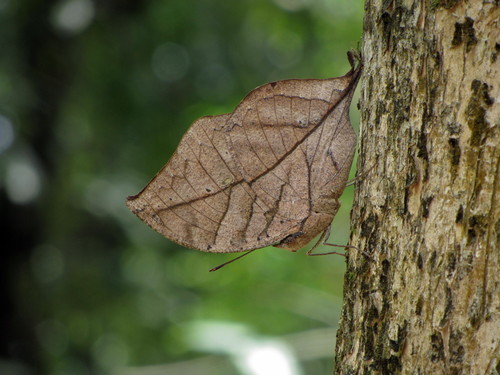
Kallima inachus Boisduval, 1836 is a butterfly commonly known as the orange oakleaf, oakleaf, or dead leaf butterfly. When its wings are closed, their shape matches that of a leaf, and only cryptic underside markings are visible. These markings consist of irregular patterns and striations in many shades of biscuit, buff, brown, yellow, and black, with darkened veins that resemble the veins of a real leaf. This extremely realistic resemblance to a dried leaf is a masquerade defense that gives its genus the common names oakleaf and dead leaf. When the wings are open, the forewing has a black apex, an orange discal band, and a deep blue base. Two white ocelli are present: one along the margin of the apical black band, and another bordering the orange and deep blue areas. The hindwing is more uniformly blue, with diffuse brown patches along the termen. Male and female Kallima inachus are similar in appearance, except the female is generally larger, and has a longer protruding point at the forewing apex. Females also tend to have a more reddish underside, and their yellow mottled markings are paler. This butterfly exhibits polyphenism, with distinct dry-season and wet-season forms that differ in coloration and size; the wet-season form is typically smaller. The wingspan of this butterfly ranges from 85 to 110 millimetres (3.3 to 4.3 in). A more detailed description of this species is provided in Bingham (1905).
This species is distributed across South and East Asia. It is found in India, Nepal, Bhutan, Bangladesh, and Myanmar, extending south to the Tenasserim Hills. In Southeast Asia, it occurs in southern China, Thailand, Laos, Taiwan, and Vietnam. It was first recorded in Pakistan in 2000. In India, it flies in low elevations of the Himalayas, from Jammu and Kashmir through Garhwal and Kumaon to West Bengal, Sikkim, Arunachal Pradesh, and other northeastern states. It is also found in central and peninsular India, where it occurs in Madhya Pradesh, Jharkhand, Chhattisgarh, Orissa, and Andhra Pradesh. This range extends along the central Indian highlands to Pachmarhi and Amarkantak, the Western Ghats south to Bhimashankar, and the Eastern Ghats north of the Godavari River. Kallima inachus is classified as "not rare" in India, but is considered "rare" in China. It can be found at altitudes up to 1,800 metres (5,900 ft) in hills, though Mark Alexander Wynter-Blyth recorded encounters up to 8,000 feet (2,400 m) in high-rainfall, thickly forested mountainous and hilly regions. In the Kumaon Himalayas, it inhabits tropical deciduous forest between 400 and 1,400 metres (1,300 and 4,600 ft), and subtropical evergreen forest above 1,200 metres (3,900 ft). A 1998 to 2004 survey of Chongqing municipality, China found this species inhabiting moist broad-leaf forests.
In the Himalayas, Kallima inachus is multivoltine, and flies from April to October. Kehimkar (2009) records the butterfly on the wing from April to December across India. In Chongqing, one generation takes approximately 50 days to develop from egg to adult imago. The egg stage lasts around 6 days, the larval stage lasts 36 days with 5 to 6 instars (most often 5), and pupation lasts around 10 days. Caterpillars bred successfully at temperatures between 22 and 31.5 °C (71.6 to 88.7 °F) and relative humidity between 48 and 98%. In captive breeding conditions, the larval period can be shortened from the 36 days seen in natural conditions to 16.8 to 23 days. In a study of the Emei mountains of China (at 450 to 1,200 metres altitude), the butterfly has three generations per year, with the first and second generations being most common. Most individuals of the second generation, along with a small number of third and occasionally first generation individuals, overwinter as diapaused adults. Most second generation adults enter diapause in early July. In the same Emei Mountains study, first generation butterflies reared in captivity completed their full life cycle in 45 to 54 days, with eggs taking 4 to 6 days, caterpillars 21 to 36 days, and pupation 10 to 15 days. Captive breeding in this study occurred at average temperatures between 26.4 and 28.2 °C (79.5 to 82.8 °F) and average relative humidity between 63.2% and 84.7%. Investigations in an artificial climate chamber show that photoperiod and temperature both affect larval development and larval survival rate for this species. Photoperiod affects larval development period at 20 °C (68 °F), but has no effect at 25 °C (77 °F) or 30 °C (86 °F). When temperature increased from 20 °C to 25 °C and 30 °C, larval developmental periods decreased under the same photoperiod, falling to 31.7 to 36.0 days, 26.37 to 27.4 days, and 21.0 to 21.5 days respectively. Increasing temperature also increased larval survival rate across different photoperiods. Larval survival rates were 80%–92% at 20 °C, 75%–95% at 25 °C, and 55%–85% at 30 °C. The low survival rate seen at 30 °C across most photoperiod gradients means artificial breeding of this species should be carried out at temperatures below 30 °C.
Kallima inachus larvae are polyphagous, and feed on plants from many different families. Recorded food plants include: Girardinia diversifolia (family Urticaceae) in India; Polygonum orientale (family Polygonaceae) in India; Prunus persica (family Rosaceae) in India; Dicliptera chinensis (family Acanthaceae) in China; Hygrophila salicifolia (Acanthaceae) in Japan; Lepidagathis formosensis (Acanthaceae) in Taiwan; Ruellia capitataus (synonym Strobilanthes capitatus & S. pentastemonoides) (Acanthaceae) in India and Taiwan; Rostellularia pracumbens (Acanthaceae) in China; and multiple Strobilanthes species (Acanthaceae) in China and Japan, including S. flaccidifolius in Japan, S. glandulifera in Japan, and S. tashiroi in Japan.