About Kalanchoe pinnata (Lam.) Pers.
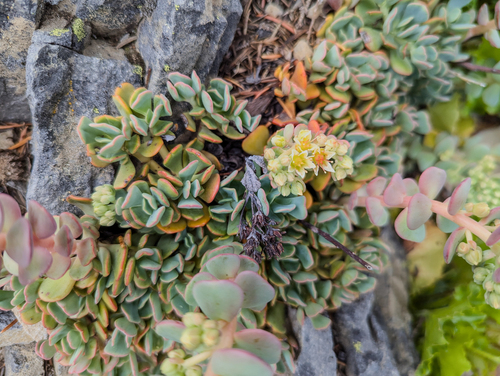
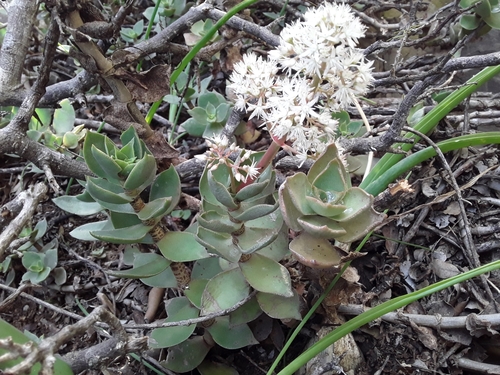
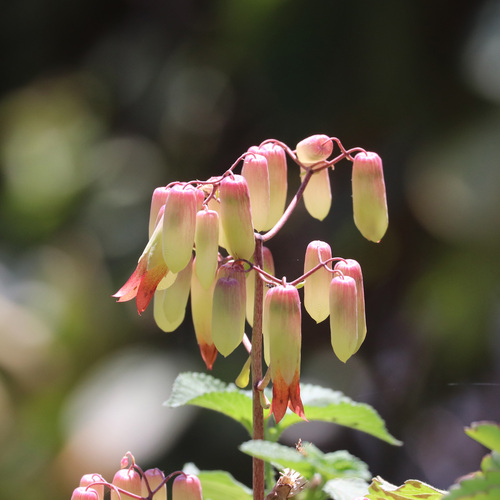
Kalanchoe pinnata (Lam.) Pers. has thick, fleshy leaves that are elliptical, curved, and often reddish, with either crenate or serrated margins. Leaves at the base of the stem are simple, while leaves at the top of the stem are imparipinnate. Leaves range from 10–30 cm (4–12 in) long, with three to five pairs of fleshy limb lobes. A notable feature of this species is that its leaves can produce bulbils. Adventitious buds form at the leaf margin between the teeth, and these buds go on to develop roots, stems, and leaves. This ability is a fairly common trait for species in the section Bryophyllum. The plant produces terminal panicle inflorescences that hold many pendent red-orange flowers. Fruits are 10–15 mm follicles, held within the persistent calyx and corolla. The calyx forms a long tube that is red at the base, veined with yellowish green (or green with reddish brown spots), and ends in four very small triangular lobes. The corolla is also tubular, with a distinct constriction that separates its subspherical lower part from its ovoid upper part, and ends in four lobes. The full corolla reaches 5 cm (2.0 in) in length, and is yellowish with red-purple streaks. There are eight stamens, arranged in two whorls, fused to the corolla, each about 4 cm (1.6 in) long. The ovary is made of four carpels that are slightly fused together at the center, and bears slender styles. This species is native to Madagascar. It has become naturalized across tropical and subtropical areas, growing in warm and temperate climates from sea level up to 2,600 m (8,500 ft). It grows on rocky sites in tropical evergreen forests, dry deciduous forests, and montane forests. It can be found in parts of Asia, Africa, Australia, New Zealand, the West Indies, Bermuda, Macaronesia, the Mascarenes, Brazil, Suriname, the Galapagos Islands, Melanesia, Polynesia, and Hawaii. In many of these areas, such as Hawaii, it is considered an invasive species. Its widespread naturalization is mostly due to its longstanding popularity as a garden plant. Like other species in the Crassulaceae family, including certain members of the genera Tylecodon, Cotyledon and Adromischus, Kalanchoe pinnata contains bufadienolide cardiac glycosides. These compounds can cause cardiac poisoning, particularly in grazing animals. Bryophyllum pinnatum (a synonym of this species) is recorded as a traditional hypertension treatment in Trinidad and Tobago. In other traditional medicine practices, leaf juice from Kalanchoe pinnata is used to treat kidney stones. While this use is the subject of ongoing research and has some supporting scientific evidence, further research is still needed. In the French Antilles, where the plant is locally called zeb maltet, it is applied topically to treat headaches. Among Amazonian communities, Kalanchoe pinnata has multiple traditional uses: Creole people use roasted plant material to treat inflammation and cancer, drink it as an infusion, and use it as a common remedy for fevers. The Palikur people of Brazil and French Guiana treat headaches by applying a preparation of leaf juice mixed with coconut oil to the forehead. In temperate regions, Kalanchoe pinnata is grown as an indoor ornamental plant. Like most succulents, it cannot survive hard frost and will not thrive when temperatures drop below 10 °C (50 °F). It grows best in well-drained soil, because its roots are prone to rot if kept too wet. In the tropics, it is grown outdoors in home gardens, and it often escapes cultivation to become naturalized, frequently establishing as an invasive weed.