About Kalanchoe daigremontiana Raym.-Hamet & H.Perrier
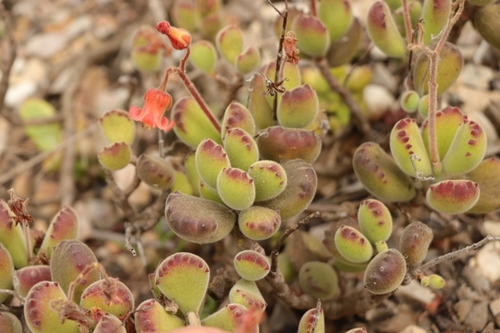
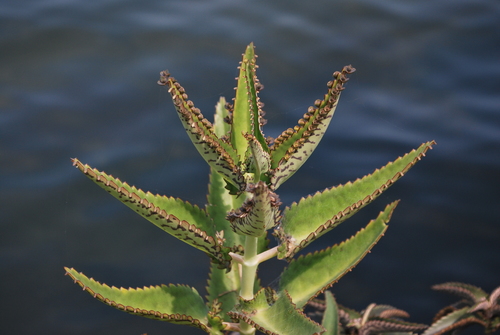
Kalanchoe daigremontiana Raym.-Hamet & H.Perrier is a succulent plant that grows up to 1 meter (3 feet 3 inches) tall. It produces opposite-decussate, fleshy leaves that range in shape from ovate to elongated-triangular, reaching up to 20 cm (8 inches) long and 5 cm (2 inches) wide. The upper surface of the leaves is green, while the lower surface is marked with purple blotches. The leaf margins hold spoon-shaped bulbiliferous spurs that produce plantlets, which can grow roots while still attached to the parent leaf. Individual plants may also develop lateral roots on their main stalk, growing as high as 10–15 cm (3.9–5.9 inches) above the ground. Large upper leaves can weigh the main stalk down and bend it downward; this lets the exposed lateral roots enter the soil, and new vertical shoots can grow from the original parent shoot. This species spreads both through seeds, and through plantlets that drop from its leaves. Kalanchoe daigremontiana produces an umbrella-like terminal compound cyme inflorescence made up of small bell-shaped flowers that are grayish pink, and sometimes orange. Flowering does not happen every year; it occurs sporadically, and may not occur at all on some shoots. In climates with distinct seasonal temperature differences, flowering is most often seen at the start of the warm season. Indoor plants, and balcony plants moved indoors to survive cold seasons, begin flowering in early winter. As a succulent, Kalanchoe daigremontiana can survive prolonged drought periods with little to no water. During growing periods with higher temperatures and increased water access, this species needs adequate nutrition; without it, leaves develop nutrient deficiency symptoms including stunted, crippled growth and pustule-like lesions. It is not frost-hardy, and typically dies in locations where temperatures drop below freezing. This species is native to the Fiherenana River valley and Androhibolava mountains in southwest Madagascar. It has been introduced to many tropical and subtropical regions, including Florida, Puerto Rico, Hawaii, Venezuela, Argentina, Brazil, Uruguay, and parts of southern Europe. Kalanchoe daigremontiana prefers to grow in dry, rocky places. It can become an invasive plant that threatens natural ecosystems, especially in arid and semi-arid environments such as South Africa and parts of South America, where it can prevent native plant recruitment.