About Kalanchoe beharensis Drake
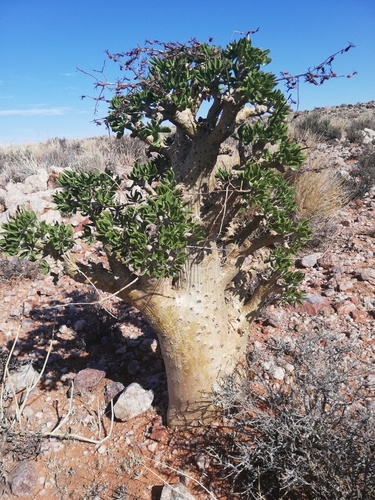
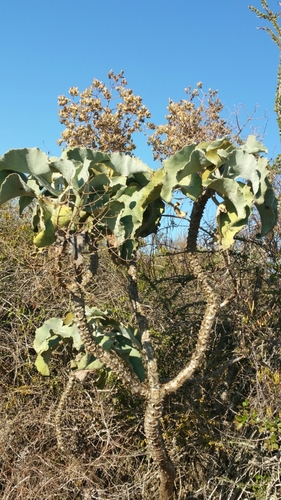
Kalanchoe beharensis Drake is an evergreen shrub that reaches 3 to 5 feet (1 to 2 meters) in height. Its stem is roughly 1.5 meters (4.9 feet) long, slender, and knotted. Its leaves are olive green, shaped like a triangular lance, and arranged decussately—meaning each pair grows at right angles to the pair below it. Leaf margins are doubly crenate, giving them a crinkled appearance. Each leaf measures about 10 centimeters (4 inches) long and 5 to 10 centimeters (2 to 4 inches) wide. The lower surface of the leaves is glabrous, meaning it is smooth and glossy, while the area toward the leaf apex is covered in woolly brown hair. The tips of the leaf margin teeth are darker in color. White hairs cover the stem, young leaves, and petioles (leaf stalks). Older leaves characteristically develop a concave upper surface.
Trichome types differ across Kalanchoe species, and these different types indicate adaptation to specific environments. On the leaf blade of K. beharensis, non-glandular, bushy three-branched trichomes are present. This type of trichome is dead and contains detectable tannin. K. beharensis trichomes also have striped cuticular ornamentation on their surface. Glandular trichomes are also present on the plant's leaves; they are more abundant on petioles than on leaf blades, and more abundant on the upper leaf surface than on the lower leaf surface.
Members of the Kalanchoe genus can reproduce asexually by producing plantlets on leaf margins. When these plantlets reach a suitable substrate, they grow into new plants. Plantlet-forming Kalanchoe species fall into two categories. Induced plantlet-forming species produce plantlets when under stress, while constitutive plantlet-forming species produce plantlets spontaneously. Induced plantlet-forming species have a functional LEC1 gene that lets them produce viable seeds, while constitutive plantlet-forming species have a defective LEC1 gene and cannot produce seeds. K. beharensis produces both seeds and plantlets.
K. beharensis can be grown as a houseplant in a bright, sunny window with sufficient air circulation to prevent insect pest outbreaks. It can be grown outdoors in mostly frost-free climates. It is naturally toxic to humans and cats, and can cause irritation and itching when it touches exposed skin. According to the National Animal Poison Information network, the species is reportedly not toxic to dogs when the plant has not been treated with any chemicals. This plant grows best in full to partial sun, with intermediate to warm temperatures above 5 °C (41 °F). It can survive occasional light to moderate frost, though it prefers to avoid frost entirely. When grown in a greenhouse, it does well in a growing medium made of equal parts loam and sand, plus one additional part of perlite, pumice, or another inert material to improve aeration and drainage. The growing medium should be allowed to dry out completely between waterings, as excess water will kill the plant. During the growing season, water every 10 to 14 days. In winter, water sparingly, typically only once every 30 days. The species is highly resilient and can survive periods of neglect, as long as it is not exposed to prolonged harsh direct sun. Propagation can be done by seed, but it is most frequent and effective when done via cuttings. New plants can be grown from any stem, petiole, or leaf cutting; the mid-rib can be cut in multiple places, since the entire plant readily produces new roots when divided. Cuttings should be grown in a sandy, loose substrate, kept out of direct sun, and provided with plenty of bright shade and indirect light. Dried sphagnum moss is also a suitable propagation substrate, as it absorbs enough moisture for developing plants while remaining sufficiently aerated to prevent rot. Propagation from leaf cuttings is highly successful in most cases, because K. beharensis leaves not only grow roots at the base or cut site, but also form new plantlets directly from the leaf surface, often in random locations. Both Kalanchoe beharensis and its cultivar 'Fang' (a cross with Kalanchoe tomentosa) have received the Royal Horticultural Society's Award of Garden Merit.