About Junonia villida Fabricius, 1787
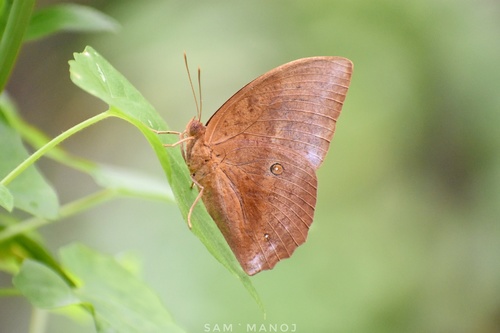
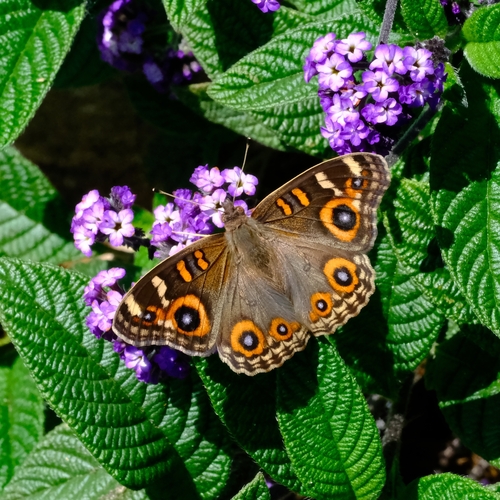
The meadow argus (Junonia villida Fabricius, 1787) has two brownish wings. Each wing is marked with two distinctive black and blue eyespots, plus white and orange marks along the wing edge. These eyespots act as a defense mechanism: they frighten predators away, and also confuse predators into attacking the eyespots instead of the butterfly’s body, letting the butterfly escape with only a small portion of its wing lost. The underside of the wings is mostly unmarked, with the exception of the lower part of the forewing, which has markings similar to those on the wing’s upperside. Males have a wingspan of 4 centimetres (1.6 inches), while females have a wingspan of 4.3 centimetres (1.7 inches). When resting, the meadow argus uses four different positions based on the current situation. If the sun is shining, it will open and relax its wings. If danger approaches while it is sunny, the butterfly will open its wings further to reveal eyespots on its hindwings. If the sun is not shining, the butterfly will close its wings. If danger approaches when there is no sunlight, the butterfly will raise its forewings to reveal hidden eyespots. The meadow argus is found primarily on the Australian mainland, and also occurs in Tasmania, Kangaroo Island, Lord Howe Island, New Zealand, Norfolk Island, Fiji, Papua New Guinea, Indonesia, Tuvalu, Samoa and the Cook Islands. Sightings of this butterfly are now rare in New Zealand, but in late 1886 thousands of meadow argus butterflies drifted across the Tasman Sea to the country. This species lives in urban areas, forests, woodlands, grasslands, and along roadsides, and is uncommon during the winter months. Each year in October or November, meadow argus butterflies migrate from southern Australia to warmer areas in the north.